
Table of Contents
- Simona Ondrejkova Is A CFP® Professional And Marketing Strategist for other CFPs® WriterAnd Writer
- AI Search Engine Optimization (AEO) for CFPs Versus Search Engine Optimization (SEO)
- Limits of AI Search Engine Optimization for CFPs
- Distinguish education, advice and promotion
- Choose questions around consumer information needs
- How Ondrejkova’s learning objectives guide SEO and AEO
- Build credible answers with evidence and accountability
- The live class will be followed by a self-study DOCE
- FAQs
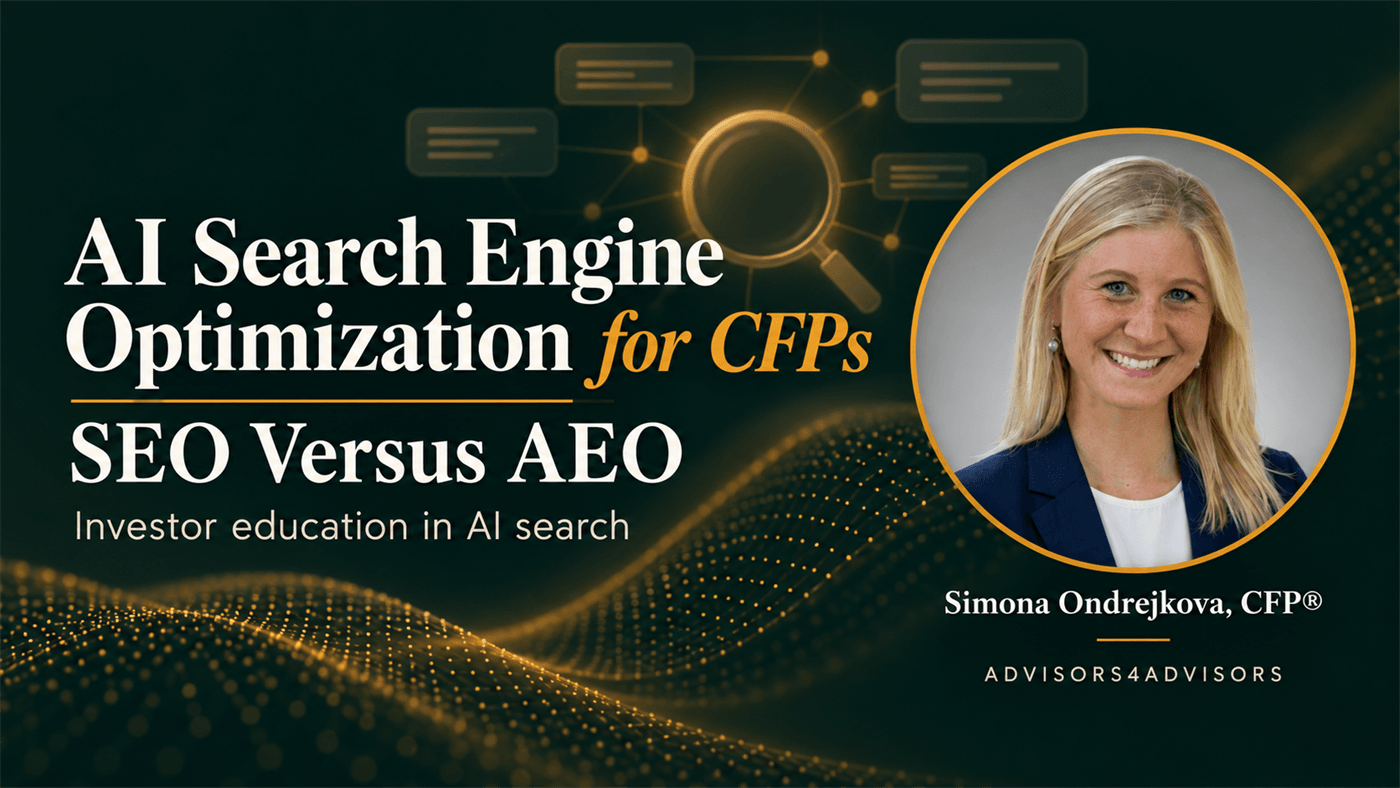
AI Search Engine Optimization for CFPs® means making useful investor education easier to discover and understand through AI-powered search. It combines established search engine optimization (SEO) with attention to how answer engines retrieve, summarize and cite explanations. Answer engine optimization (AEO) describes that second emphasis. The professional question connects both approaches: will consumers understand the answer, its assumptions and the limits of what it can tell them?
That question drives Simona Ondrejkova, CFP®’s October 22, 2026, live class, Professional Responsibility, Investor Education and AI Search Engines, from 4–5 p.m. Eastern. The program is approved for 1 hour of CFP CE (ID 354015). View the class and register. If you miss the live class, a self-study version will be published within a week after the live event. A4A delivers self-study classes as doucments optimized for CE (DOCEs®), podcasts and webinars.
Simona Ondrejkova Is A CFP® Professional And Marketing Strategist for other CFPs® WriterAnd Writer
Simona Ondrejkova, CFP®, was the financial planning professional on a wealth management team at a Merrill Lynch for eight years, helping clients turn their dreams into plans. Eventually she took her own advice and built a career with the flexibility to travel the world. Today she helps financial planning professionals across the U.S. communicate what they know, clearly and responsibly.
AI Search Engine Optimization (AEO) for CFPs Versus Search Engine Optimization (SEO)
SEO helps people discover a page through search results. AEO emphasizes explanations that answer systems can interpret and use. Traditional search often sends readers to a website; AI search may present a synthesized answer with links to supporting sources. A reader may encounter only a short passage from a longer discussion, so important qualifications need to travel with the explanation.
AI search engine optimization for CFPs builds on established SEO practices. Google’s guidance for AI search features says established SEO practices remain relevant and no special AI markup is required. Clear writing and reliable sources help readers, but no format guarantees visibility or accurate quotation. In practice, the best way to increase the chances of showing up on both SEO and AEO may include:
- Make sure pages can be found. Search engines need to be able to crawl and index them.
- Answer the question early, in plain language, under clear headings.
- Keep key caveats right next to the answer, not buried at the bottom of the page.
- Show who wrote it and when: author, credentials and the date it was last updated.
- Cite primary sources, like the IRS or SSA, and keep figures current.
Limits of AI Search Engine Optimization for CFPs
The first objective examines investor circumstances and the harm that can follow when general education is mistaken for individualized advice. Financial planning connects personal facts, goals, analysis, recommendations, implementation and monitoring. A public explanation can describe that process. It cannot perform the missing personal analysis for every reader who finds it through search. Recognize and address the limitations in what your answers to financial planning questions online.
For example, consider a retirement-planning focused blog post telling everyone to maximize retirement contributions: One reader may carry expensive debt; another may lack emergency savings. An educational answer should explain the factors that change the decision. State the assumptions beside the conclusion and identify when individual analysis is needed. This matters for search snippets and AI summaries, where surrounding context may be absent.
Distinguish education, advice and promotion
The second objective asks participants to evaluate how a reasonable investor would understand a communication. Calling an article “education” does not determine its effect. Its wording, omissions, presentation and commercial context all shape the message. Responsible AI search engine optimization for CFPs starts with reviewing how a reasonable investor would understand a page before working to put it in front of a wider audience.
A rollover article illustrates the problem. Suppose it describes only IRA advantages, omits reasons to remain in an employer plan and invites readers to hire a firm that earns rollover-related fees. A disclaimer cannot supply the missing balance. Participants examine purpose, incentives, alternatives and likely reader understanding, then decide what needs qualification, revision, disclosure or further review.
Choose questions around consumer information needs
A third objective focuses on recurring consumer questions and an appropriate educational scope. Start with what an investor needs to understand. Questions about Roth and traditional IRAs, adviser compensation or the meaning of fiduciary can support useful explanations. The topic should serve the reader’s information need, with a clear boundary between explaining a decision and making it.
“Should I convert my IRA to a Roth this year?”, for example, requires particular care. A public answer can explain the variables without claiming to reach a personal conclusion. If the answer is “it depends,” explain what it depends on. That makes AI Search Engine Optimization for CFPs® more useful: the page answers a real question while showing which facts remain unknown.
A useful exercise in AI search engine optimization for CFPs starts with one consumer question and three notes: what is known, what depends on personal circumstances and what the reader should ask next. Then compare the proposed answer with those notes. If the article skips a material condition or turns a general explanation into a recommendation, revise it before considering keywords. That sequence makes the class’s objectives part of an editorial process that a financial planning team can repeat.
How Ondrejkova’s learning objectives guide SEO and AEO
| Learning focus | Question before publication | Practical improvement |
|---|---|---|
| Investor circumstances | Which missing personal facts could change the answer? | State assumptions and explain when personal analysis is needed. |
| Education, advice and promotion | What would a reasonable reader understand? | Review incentives, omitted alternatives and the overall impression. |
| Consumer information needs | Does the page answer the reader’s actual question? | Set an educational scope and explain relevant decision factors. |
| Evidence and accountability | Can each claim be supported and kept current? | Verify sources, retain review records and assign correction responsibility. |
Build credible answers with evidence and accountability
The remaining objectives build on these foundations. Participants analyze how competence, compensation, conflicts, disclosure and fiduciary duties shape a message. They consider when selective emphasis or omissions require substantiation, qualification, attribution, disclosure or firm approval. This is professional judgment applied to the content a consumer actually encounters.
Participants also practice answer-first writing that preserves assumptions and limitations, evaluate source authority and currency, and assess responsibility for AI-generated errors. A fluent draft still needs review. Check whether a cited source supports the specific claim, addresses the situation being discussed and leaves relevant uncertainty unresolved. Consider conflicting evidence before publishing a confident conclusion.
For an explanation of adviser compensation, describe the arrangements and the conflicts they can create. Give readers enough context to ask informed questions. A label alone cannot establish whether an adviser’s incentives fit a particular investor’s needs. The same care applies when software proposes a concise definition that leaves those distinctions out.
Read only the opening two sentences of your draft. Alone, would they remain accurate if an answer engine reused them? Move a material qualification in front or beside the answer when necessary. This improves AI Search Engine Optimization for CFPs® by making the source more useful to human readers.
Try this quick test: read only the first two sentences of your draft. If an AI tool quoted just those two sentences, would they still be accurate on their own?
If not, move the key caveat up, into or right next to the answer. It’s a small edit that helps twice: human readers get the full picture faster, and an AI summary is less likely to leave out the part that matters.
Let’s try an experiment: Read only the opening two sentences of your draft. Alone, would they remain accurate if an answer engine reused them? Move a material qualification in front or beside the answer when necessary. This improves AI Search Engine Optimization for CFPs® by making the source more useful to human readers.
The final objectives address approval, recordkeeping, review, prompt correction and responsible discoverability. Assign responsibility for checking dated information and correcting errors. Preserve the reason for a material revision. Visibility increases the importance of those controls because an incomplete or outdated explanation may reach people far beyond its original audience.
The live class will be followed by a self-study DOCE
The live class will be followed within a week by a self-study version of the class DOCE®, consisting of a document optimized for continuing education developed from the live webinar. Learners can read the organized teaching material at their own pace, search it, revisit explanations and print it or read it on a phone, tablet or computer. Or you can watch the class in a MP4 webinar replay. The full self-study course requires completing three unscored learning activities and a scored assessment.
To learn about AI search engine optimization for CFPs, register for Simona Ondrejkova’s October 22 live class.
FAQs
What is the difference between SEO and AEO for CFPs?
SEO helps readers find pages. AEO emphasizes answers AI may retrieve and summarize. Neither guarantees visibility.
Is Simona’s live class CFP Board approved?
Yes. Live program 354015 grants one general CFP CE hour. It does not satisfy the separate CFP Board Ethics CE requirement.
What is the planned self-study DOCE?
A DOCE is a document-based continuing education course. Learners read at their own pace and complete required activities and assessment. Release and self-study credit status will be announced separately.