Table of Contents
- A trusted source of AEO, GEO, SEO techniques for financial institutions
- 10 AEO Examples Evidence Credibility
- Why start with Fritz Meyer’s continuing education content?
- What do SEO, AEO, and GEO for financial advisors mean?
- 1. Give AI both the slides and the transcript
- 2. Build a reusable fact table
- 3. Customize the assignment to your advisory practice
- 4. Use the evidence in asset allocation discussions
- 5. Give stock pickers a framework for explaining their research
- 6. Put the ideas into your own voice
- 7. Start with a question clients actually ask
- 8. Strengthen AEO with a direct opening answer
- 9. Support SEO with useful titles and descriptions
- 10. Make every important claim traceable
- 11. Show who wrote and reviewed the article
- 12. Adapt the discussion to different life stages
- 13. Serve ethnic and language communities thoughtfully
- 14. Address religious interests people have identified
- 15. Explain one chart in several accessible formats
- 16. Compare the present with a documented historical episode
- 17. Connect related articles into a useful library
- 18. Check that your website makes the content accessible
- 19. Connect each article to a useful conversation
- 20. Keep the system current and improve it
- Put SEO, AEO, and GEO for financial advisors into practice
- FAQs
This practical guide to SEO, AEO, and GEO for financial advisors is for beginners who want AI search engines to use their content when answering questions. The 20 techniques give you an organized strategy: research a client question, write a clear answer, show your sources, and publish useful content in your own voice.
These are field-tested techniques I have used to get Advisors4Advisors content included regularly in AI-generated answers. This guide shows you how to apply the same organized approach to your own client education.
A real example: “best IAR CE.” In an Oct. 26, 2026, check, Google AI Mode included Advisors4Advisors in its answer and linked to our article targeting “best IAR CE provider”. Try “best IAR CE” in Google AI Mode, then compare the answer with the source article. Notice the article’s focused subject, descriptive subheads, and FAQs—features you can use when answering questions from financial consumers on the web in social or blog posts. AI answers vary with timing and personalization, so your result may differ. But these techniques do work, as I am about to prove beyond doubt.
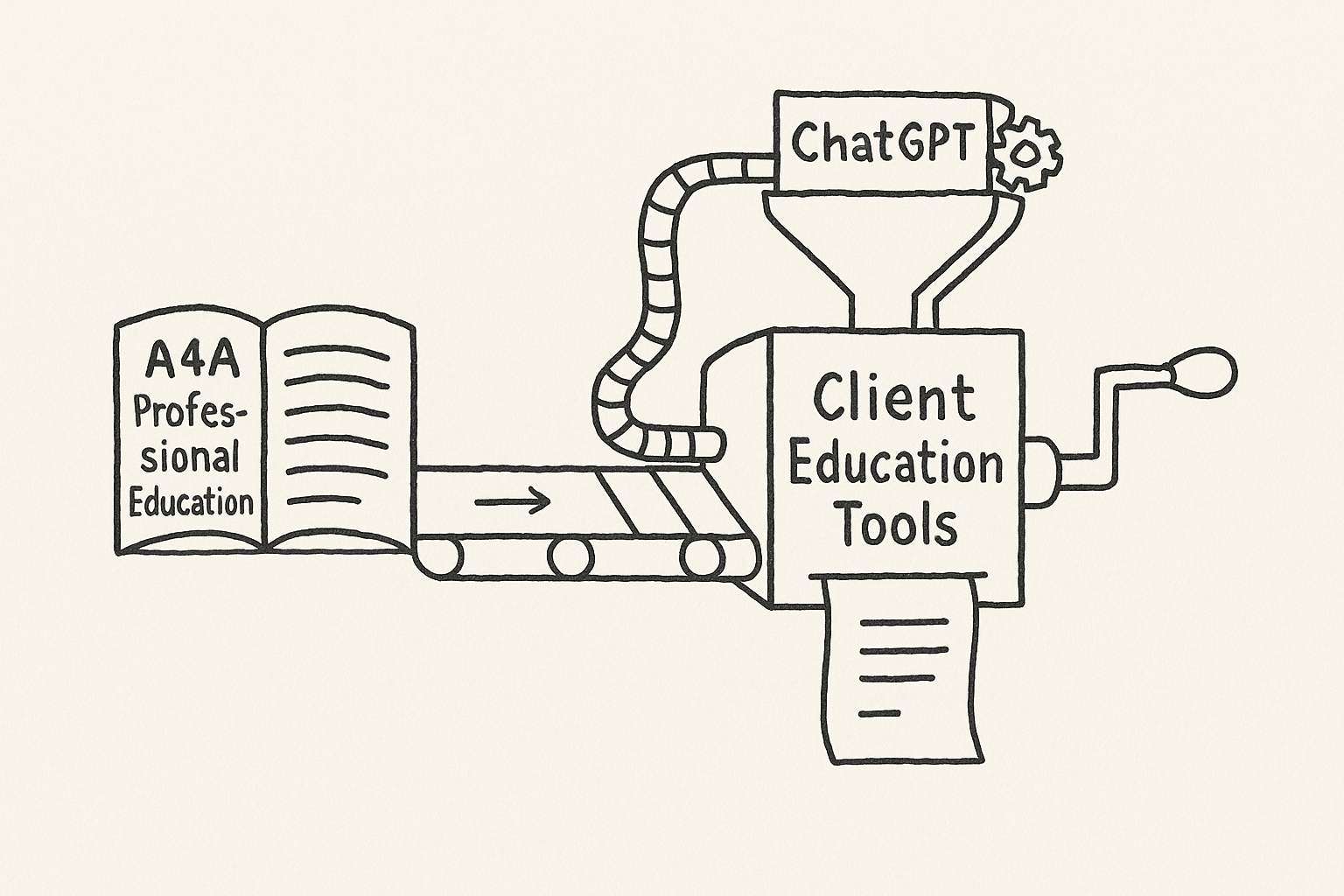
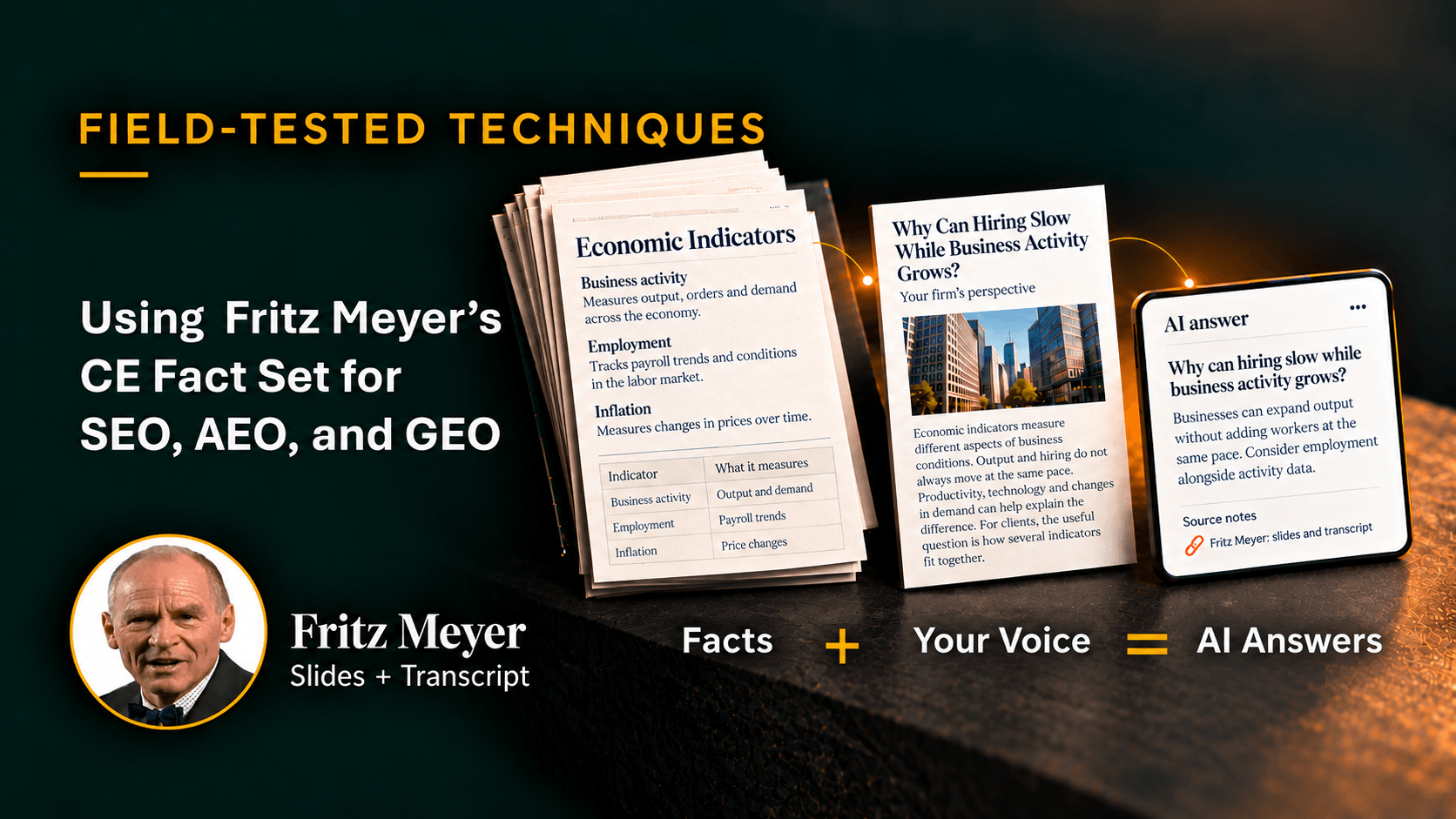
The 20 techniques detailed below can be implemented using Fritz Meyer’s slides and transcript available. That provides an editable PowerPoint PPTX slide presentation and a Word document with all of the slides and a transcript of the webinar. You can use these materials to turn economic research into helpful articles, chart explanations, and videos that offer SEO, AEO, and GEO for financial advisors, field-tested techniques.
A trusted source of AEO, GEO, SEO techniques for financial institutions
These 10 A4A articles appeared as cited sources in Google AI Mode answers on Oct. 26, 2026. Click a search phrase in the middle column to try it and see if our work succeeded. Or open the article by clicking on the article to study the techniques used. Don't mean to brag. Just want to show why you can trust A4A.
10 AEO Examples Evidence Credibility
Two articles appeared for the same “fastest way to get IAR CE credits” search, illustrating how a related content library can supply more than one source. These observations document inclusion in Google AI Mode; they do not establish placement in Gemini, and results can vary by date and personalization.
A financial and tax planner can use the material to support asset allocation discussions. A stock picker can use it to explain the economic assumptions behind company research. A retirement specialist can connect national economic developments to questions about household spending and financial security.
AI helps you organize the evidence and prepare explanations. You supply the professional judgment, the understanding of your clients, and the final words.
The opportunity also extends beyond one month’s presentation. You are drawing on decades of investment knowledge, economic history, and experience translating complex information for investors.
Why start with Fritz Meyer’s continuing education content?
A recurring research source gives your writing continuity. You can revisit the same economic questions as new evidence appears, explain what changed, and show readers how you evaluate conflicting signals.
Fritz’s background includes more than a decade as a senior strategist at Invesco. He began teaching on Advisors4Advisors in March 2011, bringing a recurring framework for examining growth, employment, consumers, inflation, earnings, valuations, and interest rates. Fritz Meyer’s background
Alongside Fritz’s original research, Andrew Gluck developed more than a decade of weekly investment and financial planning commentary drawing on Fritz’s analysis. The archive includes quarterly market summaries, articles, scripts, organized weekly videos, charts, animated GIFs, and a dashboard of content advisors could distribute.
Located source materials reach back to 2013, including quarterly market summaries, with later collections documenting weekly updates and video production. These files show how economic research became explanations people could use.
The historical advisor content program cleared all RIA and broker-dealer compliance hurdles for its intended distribution. Newly customized content still needs the review required by your own firm.
Keep the authorship clear: Fritz’s slides and direct transcripts document his teaching. Andrew’s articles and scripts document his interpretation of that research. Your new content adds another layer: your explanation for your audience.
What do SEO, AEO, and GEO for financial advisors mean?
SEO helps people find your website through search. AEO emphasizes clear answers to questions. GEO describes efforts to make content useful and discoverable in generative AI search experiences. For an advisory practice, all three begin with the same assignment: explain a topic your clients care about, using evidence they can assess.
You do not need to complete all 20 techniques or follow them in numerical order. Choose one client question, gather its supporting material, and build one useful article first.
Whenever you create something new, begin with the relevant source materials, check the facts, and review the draft yourself. Then choose the techniques that suit your practice.
Three terms describe how the resulting content can become discoverable:
- SEO, or search engine optimization: Helping search engines understand your pages and connect them with relevant searches.
- AEO, or answer engine optimization: Making your answers clear and useful when people ask questions.
- GEO, or generative engine optimization: Improving the usefulness and discoverability of your content in AI-generated search experiences.
These practices overlap. Google explains that established SEO practices remain relevant to its generative search features. None guarantees rankings or citations. Google’s guidance on AI search
The examples below use Fritz’s October 13, 2026 materials. We’ll call ChatGPT “CGPT.”
1. Give AI both the slides and the transcript
Start a new CGPT conversation. Use the attachment control to upload the presentation and transcript. CGPT can work with uploaded presentations and documents. Official OpenAI documentation
Slides supply charts, dates, and source notes. The transcript supplies the explanation, including qualifications that a chart alone may omit.
Try this prompt:
Read these Fritz Meyer materials. Identify five topics relevant to clients of a [describe your practice]. List the supporting slides and transcript passages. Disclose all fact sources. Flag anything you cannot read. Do not draft an article yet.
If a chart is unreadable, attach a clear image. Check its labels yourself.
2. Build a reusable fact table
Reliable SEO, AEO, and GEO for financial advisors begins before the first draft. Build a fact table that keeps each claim connected to its date, source, and interpretation. You can reuse that record when preparing an article, a video script, or a client presentation.
October’s presentation offers a useful example: slides 11 and 12 discuss manufacturing and services activity, while slide 17 discusses new job formation. Together, they provide a starting point for explaining conflicting economic signals.
Try this prompt:
Create a fact table from slides 11, 12, and 17. Include the claim, measurement period, slide number, original source, and Fritz’s interpretation. Separate observations, estimates, forecasts, and opinions. Disclose all fact sources and identify which you have independently verified.
A citation printed on a slide does not establish that CGPT has checked the original publication. Review the table against the files and relevant original sources.
3. Customize the assignment to your advisory practice
Effective SEO, AEO, and GEO for financial advisors starts with a clear assignment. Tell CGPT what you do, whom you serve, and which question the article should answer. A retirement specialist and a stock picker may use the same economic data, but their readers need different explanations. Describe that need before asking AI to write.
| Your practice | A possible use of Fritz’s material |
|---|---|
| Financial and tax planning | Frame questions about asset allocation, taxes, and household cash needs |
| Individual stock selection | Explain the economic backdrop for company research |
| Retirement planning | Discuss spending concerns and uncertainty |
| Business-owner planning | Connect national indicators with uneven business conditions |
| Advice for younger professionals | Explain employment developments alongside competing financial goals |
Try this prompt:
I am a financial and tax planner serving business owners approaching retirement. Suggest three educational articles using this verified fact set. Separate economic evidence from proposed planning applications. Disclose all fact sources and identify additional research needed.
4. Use the evidence in asset allocation discussions
Financial and tax planners can connect economic analysis to a broader planning conversation.
October’s materials discuss earnings estimates, stock valuations, inflation, and bond yields. Those subjects can help explain the considerations behind a portfolio review.
Try this prompt:
Using the October materials, outline a client article explaining how earnings expectations, valuations, inflation, and bond yields inform an asset allocation discussion. Distinguish Fritz’s observations from my planning perspective. Disclose all fact sources. Do not recommend portfolio percentages or infer a client’s suitability.
Add tax questions using separately verified tax sources. The slides alone cannot determine account placement, withdrawal choices, or the consequences of realizing gains.
5. Give stock pickers a framework for explaining their research
A stock picker can use macroeconomic analysis to make company research more understandable.
October’s earnings and valuation slides can introduce the difference between an improving business outlook and the price investors pay for it.
Try this prompt:
Draft an educational explanation of how an investor might compare earnings expectations with valuation. Use Fritz’s October slides for market context. Identify the company-specific evidence needed before discussing an individual stock. Disclose all fact sources. Do not imply Fritz recommended a company.
Your company analysis remains your work. Identify its sources separately and explain where your conclusions could be wrong. This source discipline also supports SEO, AEO, and GEO for financial advisors by making your reasoning easier to assess.
6. Put the ideas into your own voice
Your own voice makes SEO, AEO, and GEO for financial advisors more distinctive. Give CGPT a short sample of your writing after removing confidential information. Explain how you speak with clients.
Try this prompt:
Explain the approved facts in my voice. Use familiar words and short paragraphs. Preserve uncertainty. Disclose all fact sources. Do not invent quotations, client experiences, or recommendations.
An original explanation inspired by October’s mixed signals might read:
“Businesses can stay busy while adding fewer employees. That helps explain why economic headlines sometimes disagree. In a planning review, we consider several indicators together and discuss what uncertainty means for your household.”
That is an illustrative paraphrase, not a Fritz quotation. Read your draft aloud and change anything you would never say.
7. Start with a question clients actually ask
Client questions give SEO, AEO, and GEO for financial advisors a practical editorial focus. Start with language you hear in meetings, calls, and emails. A specific question helps you choose the evidence, write a useful headline, and recognize when the article has answered enough.
For October’s materials, possible questions include:
- Why can hiring slow while business activity remains strong?
- Does a growing economy mean stocks are attractively priced?
- Why can national spending look healthy when my household feels squeezed?
Try this prompt:
Suggest 10 client questions this fact set can help answer. Identify the evidence supporting each answer and disclose all fact sources. Flag questions these materials cannot resolve.
Choose a question you hear in your practice. Use it naturally in the headline and opening paragraph.
8. Strengthen AEO with a direct opening answer
For SEO, AEO, and GEO for financial advisors, answer the headline’s question in the opening sentences. Then explain why the answer holds, what evidence supports it, and where uncertainty remains. This gives readers a useful response even if they have time for only the first paragraph.
For example:
Does slower hiring automatically mean recession?
“Slower hiring alone cannot establish that a recession has begun. Fritz Meyer’s October presentation considered employment alongside business activity and other indicators.”
Then explain the supporting evidence, dates, and limitations.
Try this prompt:
Write a direct opening answer to this question, followed by a fuller explanation. Preserve qualifications and disclose all fact sources.
This structure helps a busy reader understand the article’s purpose before deciding how deeply to read.
9. Support SEO with useful titles and descriptions
For SEO, AEO, and GEO for financial advisors, use a title that tells readers exactly what they will learn. Place the central topic naturally in the headline, opening, and relevant subheads. A search description should explain the article’s value in a sentence or two. Repeating a phrase in every paragraph makes the article harder to read.
For an October mixed-signals article:
Search title: Why Hiring Can Slow While Business Activity Grows
Web address: /hiring-slows-business-activity
Description: Understand October 2026’s mixed economic signals and the questions they raise for your household’s financial planning.
Try this prompt:
Suggest a search title, page description, and short web address. Match the article accurately. Avoid sensational claims, repeated keywords, and promises about investment results.
Keep the date visible when the argument depends on a particular month’s evidence.
10. Make every important claim traceable
Traceable evidence is central to SEO, AEO, and GEO for financial advisors. Put sources close to the claims they support so readers and reviewers can check the explanation. Separate the underlying economic data, Fritz’s interpretation, and your own planning perspective.
For each factual claim, preserve the original provider, publication or series name, relevant date, and supporting link where available. Also identify the Fritz class or A4A article that supplied the interpretation.
Try this prompt:
Audit every factual claim in this draft. Disclose all fact sources beside the relevant claims. Distinguish an original source you opened from one cited inside another document. Flag unsupported statements and invented or inaccessible links.
Open the links yourself. A convincing-looking citation can still be wrong.
11. Show who wrote and reviewed the article
Clear authorship supports SEO, AEO, and GEO for financial advisors. Publish under the name of the person responsible for the explanation.
Use an accurate byline and a concise description of the advisor’s relevant experience. Identify the publication date and substantive updates.
Try this prompt:
Draft a short author introduction using only the professional information I provide. Explain my relevant specialty without inventing credentials, experience, or results. Preserve the article’s source disclosures.
If someone reviews the article, describe that review accurately. Your expertise should be visible through both the explanation and the supporting professional information.
12. Adapt the discussion to different life stages
When adapting SEO, AEO, and GEO for financial advisors to different life stages, keep the facts consistent while addressing the reader’s specific questions.
Someone starting a career may focus on employment uncertainty. Someone nearing retirement may ask how economic conditions relate to spending plans.
Try this prompt:
Create two introductions to the same article: one for younger professionals and one for people approaching retirement. Preserve the evidence and disclose all fact sources. Do not assume income, financial knowledge, or risk tolerance based on age.
Make each version useful for the stated need. Avoid producing multiple nearly identical public pages merely to reach different search phrases.
13. Serve ethnic and language communities thoughtfully
An advisor serving a particular community can adapt language and examples to needs people have expressed.
For instance, readers may have asked about supporting relatives while saving for retirement. That provides a useful editorial focus without assuming every family shares the same circumstances.
Try this prompt:
Adapt this approved article for Spanish-speaking readers who have asked about balancing family support and retirement saving. Preserve all economic facts and disclose all fact sources. Do not assume immigration status, income, or family structure. Flag language requiring professional translation review.
Have a qualified person review the translation and cultural context. Thoughtful language adaptation makes SEO, AEO, and GEO for financial advisors useful to the communities your practice serves.
14. Address religious interests people have identified
Religious communities can have specific educational interests, including charitable giving or investment principles.
Ask about those interests instead of assigning beliefs to people based on a label.
Try this prompt:
Adapt this article for Muslim readers who have requested education about economic conditions alongside their stated investment principles. Preserve Fritz’s economic analysis. Disclose all fact sources. Identify where qualified religious or specialist financial review is needed.
For a church community interested in giving, the application might be questions donors bring to charitable planning. Add appropriate sources for any claims beyond the economic materials.
15. Explain one chart in several accessible formats
One well-explained chart can support a short article, a video, or an animated graphic. Give each version a clear purpose and include enough written context for someone who cannot see the visual or play the recording.
Choose one message. Explain what the chart measures, its period, and what it cannot establish.
Try this prompt:
Prepare a plain-English explanation of this chart, a one-minute video script, and a storyboard for an animated GIF. Preserve labels, dates, and qualifications. Disclose all fact sources. Flag reproduction permissions that need checking.
Provide a written explanation alongside the visual. Avoid animations that make unrelated observations appear to show a causal relationship.
16. Compare the present with a documented historical episode
Historical comparisons can strengthen SEO, AEO, and GEO for financial advisors by showing how an explanation changed as new evidence developed. Use the archive to document what was known at each point.
You might compare earlier concerns about inflation, employment, or recession with a later presentation. Select periods for their relevance and examine differences as carefully as similarities.
Try this prompt:
Compare these dated materials. Explain what was known at each point, what was forecast, and what later evidence showed. Disclose all fact sources. Preserve the distinction between Fritz’s statements and Andrew Gluck’s commentary. Identify important differences between the periods.
Check original release dates and revisions so you do not give an earlier commentator knowledge available only later.
17. Connect related articles into a useful library
A connected content library supports SEO, AEO, and GEO for financial advisors by helping visitors explore related questions. Link where the next article adds context, explains a term, or answers a likely follow-up. Use descriptive link text that tells the reader what to expect.
An article about hiring and business activity can link to your explanations of consumer spending, earnings expectations, or portfolio review questions. Each page should answer a distinct question.
Try this prompt:
Review these approved articles. Suggest relevant internal links, explain why each helps the reader, and identify unanswered questions. Preserve all source disclosures. Avoid proposing duplicate articles.
This gives a new prospect a way to explore your thinking while helping existing clients find explanations they may have missed.
18. Check that your website makes the content accessible
Technical accessibility supports SEO, AEO, and GEO for financial advisors. Ask your website provider to confirm that important articles can be discovered, read on mobile devices, and accessed by the search services you intend to reach.
Keep meaningful explanations in readable page text, including when a chart, video, or download accompanies the article.
Google’s guidance emphasizes technical accessibility and useful content. It does not require special AI files or special markup for generative search visibility. Google’s technical and content guidance
Try this prompt:
Prepare a short checklist for my website provider covering article accessibility, navigation, mobile reading, and search discovery. Separate recommended checks from anything you have actually verified.
19. Connect each article to a useful conversation
Choose an invitation that follows naturally from the subject.
A tax planner might invite readers to bring questions about the interaction of portfolio decisions and taxes. A stock picker might invite questions about the firm’s research process. A retirement specialist might suggest reviewing household spending assumptions.
Try this prompt:
Write three closing invitations suited to this article and my stated services. Keep them specific and low-pressure. Do not imply guaranteed results or individualized advice from the article. Preserve the source disclosures.
Measure SEO, AEO, and GEO for financial advisors against the purpose of your practice’s content. Track relevant visits, qualified replies, and useful conversations. Review which questions bring suitable prospects to your site and which articles help existing clients understand your advice.
20. Keep the system current and improve it
Save your approved fact tables, prompts, source records, and final versions.
Each month, review what changed in Fritz’s presentation and what clients asked after reading your content.
Try this prompt:
Compare the new materials with our existing articles. Identify outdated figures, changed forecasts, useful follow-ups, and content that remains accurate as dated commentary. Disclose all fact sources. Recommend what to update, retain, or retire.
Set review dates for time-sensitive pieces. Keep publication and update dates clear, and complete your firm’s required review before distribution.
Put SEO, AEO, and GEO for financial advisors into practice
You can put SEO, AEO, and GEO for financial advisors into practice with one question from a client meeting. Find the relevant Fritz Meyer slides and transcript passages, check the sources, and write a direct answer in your own voice. Add context, complete your firm’s review, and connect the article to a useful next conversation.
Repeat the process as new research and client questions arrive. Over time, your library can show how you think, which people you serve, and how you turn economic information into understandable planning discussions.
FAQs
What are SEO, AEO, and GEO for financial advisors?
SEO, AEO, and GEO for financial advisors combines search visibility, direct answers, and useful content for AI search. Start with real client questions and check your sources.
How can Fritz Meyer’s CE support SEO, AEO, and GEO for financial advisors?
Use his slides and transcripts to research client questions. Add your own explanation, cite sources, and complete your firm’s review.
Where should advisors place their main keyphrase?
Use it naturally in the opening, relevant headings, search description, and supporting passages. Keep the explanation readable.
Do these techniques guarantee search rankings or AI mentions?
No. Clear answers, credible sources, and accessible pages support discovery, but rankings and AI citations are not guaranteed.
What is a practical first step for an advisor?
Choose one client question, find the relevant Fritz Meyer material, verify the sources, and write a clear answer in your own voice.