
Table of Contents
- Practical AI Training Context
- What This Course Covers
- Why Codex Matters For Advisory Firms
- Learning Objectives
- Self-Study Format And CE Access
- Who Should Consider This Class
- How To Use The Course
- Related A4A Resources
- FAQs
- What The Class Covers
- Two Self-Study Options
- Who Should Take This Class
- Why This Matters
- Frequently Asked Questions
- FAQs
Codex for financial advisors is becoming a practical professional skill, not a distant technology trend. Financial advisors who learn how to use Codex carefully can move faster on research, client communication, workflow design, data review, and practice-management projects while still keeping human judgment, compliance review, and fiduciary responsibility at the center of the process.
Advisors4Advisors created this one-credit self-study CE course to help advisors understand what Codex can do, where it fits in an advisory practice, and how to use it without treating artificial intelligence as magic. The class is designed for advisors who want a grounded introduction to AI-powered workflows and a repeatable way to evaluate whether a Codex project is useful, appropriate, and ready for real advisory work.
Practical AI Training Context
This AI CE course for financial advisors is built around practical Codex AI workflows for advisors rather than abstract AI theory. It functions as an IAR CE self-study course for professionals who want financial advisor AI training they can connect to RIA productivity with Codex, internal process design, and compliance-aware review. In that context, Codex for financial advisors means learning how to turn a defined business problem into a reviewed, repeatable workflow.
For advisors comparing AI education options, Codex for financial advisors should mean more than learning a few prompts. The practical test is whether Codex for financial advisors can help an advisory firm define a workflow, protect client information, review the output, and improve a repeatable business process. That is the practical promise of Codex for financial advisors: useful AI training tied to real advisory-firm work.
What This Course Covers
This course introduces Codex as a tool for building structured workflows, lightweight applications, dashboards, reports, and operational systems. Unlike a general chatbot conversation, Codex can help turn a business need into a working prototype. That matters because financial advisors often need more than a clever answer. They need a usable process that can be reviewed, improved, documented, and repeated.
The course explains how advisors can move from a rough idea to a clearer project brief. Participants learn to define the audience, purpose, inputs, expected outputs, data limits, and review requirements before asking Codex to build anything. That planning discipline is central to using Codex for financial advisors responsibly.
Examples include internal advisor dashboards, onboarding trackers, follow-up systems, client-service checklists, marketing calendars, portfolio-review notes, spreadsheet analysis, and data visualization. The emphasis is on using AI to support professional work, not replace professional judgment.
Why Codex Matters For Advisory Firms
Many advisory firms already rely on spreadsheets, documents, CRM exports, meeting notes, research summaries, and repeatable service routines. Codex can help advisors connect those pieces into more efficient workflows. For example, an advisor might use Codex to organize prospect information, summarize planning observations, create a dashboard, draft a client-service sequence, or convert a spreadsheet into a clearer written analysis.
The productivity gain is not merely faster typing. The deeper value is a better way to translate advisory knowledge into structured tools. When an advisor can describe the task clearly, Codex can help build a first version, test it, revise it, and improve it. That creates a practical bridge between business judgment and automation.
For firms with limited technology resources, Codex for financial advisors can also reduce the distance between an idea and a working prototype. A process that once required a long software request may now begin with a well-written project brief and a careful review cycle. That is why the course focuses on staged development: plan, build, test, revise, and review.
Learning Objectives
After completing the class, participants should be better prepared to:
- Explain what Codex is and how it differs from ordinary chatbot prompting.
- Identify advisor workflows where Codex may improve productivity or organization.
- Write a project brief that defines audience, purpose, inputs, outputs, and constraints.
- Use staged prompts to guide planning, building, testing, and revision.
- Evaluate Codex-generated output for usefulness, accuracy, and workflow fit.
- Recognize privacy, compliance, and data-sensitivity issues before using client information.
- Separate internal operational uses from higher-risk client-facing uses.
- Develop a repeatable framework for future Codex projects in an advisory firm.
Self-Study Format And CE Access
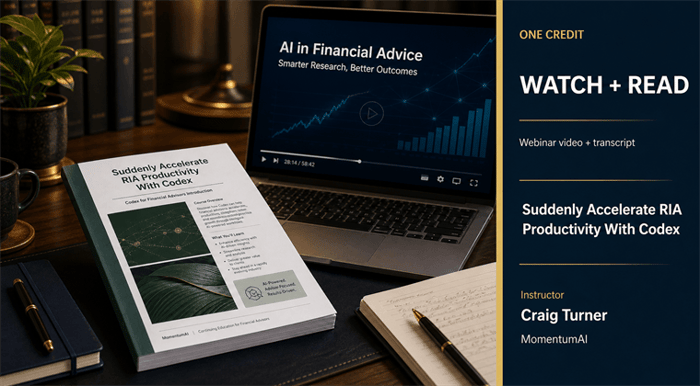
The self-study class includes reading material, a webinar-based learning option, exercises, and an assessment. The course is structured so learners can consume the material in a professional CE format and then complete the required assessment inside the course environment.
For A4A members, the course is available through membership access. Nonmembers may purchase the self-study class separately. The public blog post introduces the course and the topic, but it does not provide assessment access, quiz answers, or unrestricted CE completion materials.
The course has been approved by NASAA for one credit in Products and Practice IAR CE. Other credential-body status should be checked on the course page before making assumptions about credit eligibility. The course page includes a CE submission and approval status table so advisors can see the current status before enrolling.
Who Should Consider This Class
This class is for investment adviser representatives, CFP professionals, CPA financial planners, CPA/PFS professionals, CIMA professionals, CFA charterholders, and other professionals who want a practical introduction to AI workflows in an advisory business. It is especially relevant for advisors who want to improve internal processes, reduce repetitive work, and understand how to evaluate AI-generated output before using it in a professional setting.
Codex for financial advisors is not mainly about writing better prompts for entertainment or general productivity. It is about learning how to express a business process clearly enough that AI can help build, organize, and improve it. That makes the class useful for advisors who manage client service, planning workflows, research, marketing, onboarding, compliance documentation, or operations.
How To Use The Course
Start with the reading material and course introduction. As you move through the class, pay attention to the structure of each example: what problem is being solved, what input is required, what output is expected, and what human review is needed before the output can be trusted. This framework is more durable than any single AI tool feature.
Use the exercises to practice translating advisory tasks into clearer instructions. A strong Codex project brief should define the business goal, the intended user, the source material, the required format, and the boundaries that should not be crossed. That habit helps advisors use AI more safely and productively.
Before taking the assessment, review the course objectives and confirm that you understand the difference between internal productivity use and client-facing deployment. Human review, firm policy, privacy rules, and professional standards remain essential.
Related A4A Resources
Advisors can browse all A4A classes, read more updates on the A4A News blog, review A4A frequently asked questions, or learn more about Advisors4Advisors. The course page for Suddenly Accelerate RIA Productivity With Codex Self-Study CE includes current pricing, member access information, and credential-status details.
FAQs
What is Codex for financial advisors?
Codex for financial advisors refers to using OpenAI Codex to help build structured workflows, dashboards, reports, prototypes, and automation-supported processes for advisory-firm work. The advisor remains responsible for review, judgment, privacy, and compliance.
Does the blog post include the assessment or quiz answers?
No. This public post is an introduction to the topic and the course. Assessment access, exercises, and CE completion materials remain inside the paid or member-access course.
Is this course approved for IAR CE?
The current course page identifies NASAA approval for one credit in Products and Practice IAR CE and lists the course ID in the CE status table. Advisors should review the course page for the current status of other credential bodies before enrolling for a specific designation.
Can nonmembers take the class?
Yes. A4A members can access the course through membership, and nonmembers can purchase the self-study class separately. Nonmembers do not receive assessment access from this blog post alone.
Why does the class focus on workflows instead of only prompts?
Prompting is useful, but advisory firms need repeatable processes. The course teaches advisors to define a business problem, structure a project brief, test the output, and revise the result before relying on AI-supported work.
Continue to the full class and earn 1 CE credit.
The full self-study class includes the complete reading/webinar materials, exercises, and assessment access for CE completion.
Open Suddenly Accelerate RIA Productivity With Codex Self-Study CE
FAQs
What is Codex for financial advisors?
Codex for financial advisors is the practical use of OpenAI Codex to help build advisory-firm workflows, dashboards, reports, prototypes, and automation-supported processes while the advisor remains responsible for review, judgment, privacy, and compliance.
Does the blog post include the assessment or quiz answers?
No. This public post introduces the topic and the course. Assessment access, exercises, and CE completion materials remain inside the paid or member-access course.
Is this course approved for IAR CE?
The current course page identifies NASAA approval for one credit in Products and Practice IAR CE and lists the course ID in the CE status table. Advisors should review the course page for the current status of other credential bodies before enrolling for a specific designation.
Can nonmembers take the Codex for financial advisors class?
Yes. A4A members can access the course through membership, and nonmembers can purchase the self-study class separately. Nonmembers do not receive assessment access from this public blog post alone.
What learning formats are available?
The course supports self-study learning through reading materials and, where selected, webinar video/transcript access. The public article introduces the topic, while the course contains the full learning materials, exercises, and assessment.
Why does the class focus on workflows instead of only prompts?
Prompting is useful, but advisory firms need repeatable processes. The course teaches advisors to define a business problem, structure a project brief, test the output, and revise the result before relying on AI-supported work.