
Why the fastest way to get IAR CE credits is reading
The average college graduate can read a 50-minute CE transcript in nearly half the time it takes to watch a 50-minute webinar. Both delivery methods earn one credit. This is why the fastest way to get IAR CE credits is by reading a document optimized for continuing education (DOCE®).
For IAR, CFP, CIMA, CPA, CPA/PFS, and CFA practitioners, the fastest way to get IAR CE credits is self-study reading, responding to an interactive exercise, and passing an assessment, typically by scoring 70% or more on a 10-question multiple-choice quiz.
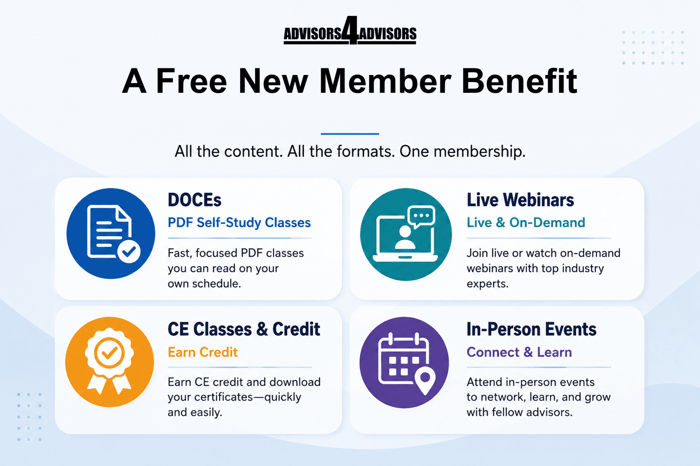
For investment adviser representatives and other financial professionals, reading-based education offers many advantages. So, Advisors4Advisors has begun offering self-study documents optimized to deliver CE credit in half the time of a webinar.
Highly formatted documents specifying fonts for headlines, sub-headlines, and text as well as yellow highlights, point sizes, and other attention getting devices are crafted in a punchy tabloid-style to make concepts memorable, easy to read and skimmable. It’s a PDF optimized for professional education. San serif fonts are always used because people read them faster, for instance.
Flexibility and control
You can read a lesson when it fits your schedule, without waiting for a live webinar at a fixed time. There's no requirement to be in front of a screen at an appointed time. Maybe you like to read first thing in the morning when your mind is fresh. Or perhaps you like to fall asleep holding a book or reading device. Reading let's you determine when you're in the mood to learn. You're in control.
Deeper Learning From CE
But the big advantage is a deeper learning experience. A well-written lesson can make learning deeper because it is clearer, better organized, and more thoughtfully tied to advisory practices than a webinar. Plus you're in control of the pace and focus. Stopping to think anytime while you're reading is natural. In a live webinar or podcast, however, information moves at a fixed speed. It's served to you and you cannot freeze it and take the time to chew on and fully digest an idea.
In addition, at a live webinar, speakers are rarely as articulate in stating their message as they are when they write every word of a class. "Ums" or "uhs" don't exist in written lessons. Nor are there stutters, misspoken explanations, or annoying tiks, like saying, "alright," every minute or two.
Consuming Information And Instructional Design
In a structured reading lesson—with headlines, subheads, tables, charts, and analysis applied to practicing—advisers are able to consume the information by skimming over what they know, slowing down to digest complex ideas, and take a bigger bite at key tidbits before the graded assessment. This reduces cognitive overload and improves retention.
Instructional design makes the difference. A 50-minute live webinar delivers content linearly. A learner must follow along with no ability to skip ahead, reorganize topics, or go over sections.
A well-designed lesson consumed by reading can present the achieve the same learning objectives in nearly half the time, and provide a deeper learning experience.
CE Delivery Method Characteristics
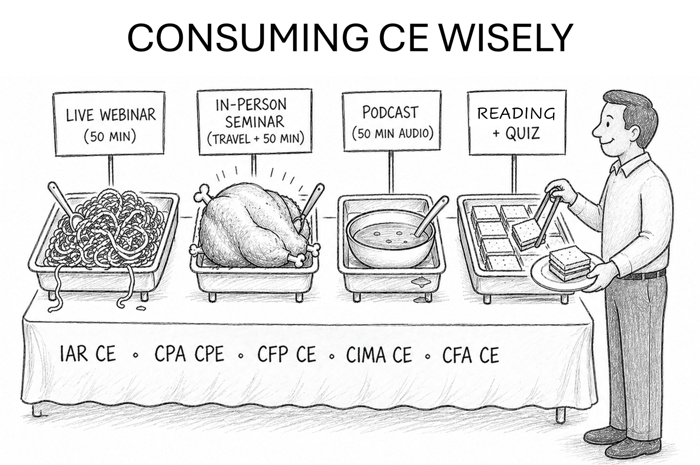
The most important characteristics of different CE delivery methods are summarized in the table below. Reading, as a delivery method, is skimmable. Audio and webinar delivery are not skimmable and you are not in control. In contrast, reading text with pithy headlines, alliteration, and vivid language is made more memorable.
The result is many advisers can move through well-designed reading material more efficiently than passive formats, while still meeting course requirements and passing assessments on the first attempt. The credit is based on the approved course design, but the learning experience can be more focused and time-efficient if its well written.
| Delivery | Structure | Interactivity | Efficiency | Notes |
|---|---|---|---|---|
| Webinar | Linear, time-bound | Moderate | Medium | Fixed pace; no skimming |
| In-Person | Linear + discussion | High | Medium | Interaction helps learning; travel reduces efficiency |
| Podcast | Linear, audio-only | Low | Low–Medium | No visuals; difficult to revisit key concepts |
| Reading | Structured, skimmable | High | High | Headlines, tables, and analysis may improve focus and retention |
Source: Advisors4Advisors | ||||
Table of Contents
- Why the fastest way to get IAR CE credits is reading
- Flexibility and control
- Deeper Learning From CE
- Consuming Information And Instructional Design
- CE Delivery Method Characteristics
- Get IAR CE fast without weakening learning
- How the 50-minute CE credit standard usually works
- A 9,600-word reading guideline
- The fastest way to get IAR CE credits through reading lessons
- Written analysis derived from webinar transcripts improves self-study IAR CE
- Sample DOCE: Investor Personality & Fiduciary Practices IAR CE
- The fastest way to pass IAR CE quizzes
- How self-study supports fiduciary application
- Choosing the fastest way to get IAR CE credits wisely
- FAQ:
- What is the fastest way to get IAR CE credits?
- Can IAR CE credits be earned by reading?
- Does reading count the same as watching a webinar?
- Is the fastest way to get IAR CE credits always self-study?
- What is the 9,600-word guideline?
- Is 9,600 words an official NASAA rule?
- Why does one CE credit often equal 50 minutes?
- Can advisers speed up CE by reading faster?
- Do self-study IAR CE courses require a quiz?
- Are open-book IAR CE exams allowed?
- Why do open-book exams weaken learning?
- Why add analysis to a webinar transcript?
- Is analysis duplicative of a transcript?
- Can analysis shorter than the transcript add CE credit?
- Does self-study IAR CE help fiduciary practice?
- What should advisers look for in self-study CE?
- Can self-study IAR CE also count for CFP, CIMA, CPA, PFS, CFA credit?
- What is the best self-study IAR CE format?
- FAQs
Get IAR CE fast without weakening learning
Some courses make it easy to search a transcript for quiz answers. One giant IAR CE provider is advertising their classes as open-book quizzes. However, the fastest way to get IAR CE credits should not reduce the learning experience to a menial task, searching a document for the the quiz answers. It may be convenient but it's a weak learning model for fiduciaries.
IARs as well as professionals deserve a genuine learning experience in which they internalize ideas taught by an instructor. Producing more than a thousand hours of CE and CPE over the past 16 years has taught me that the best self-study classes contain concise reading, clear learning objectives, practical knowledge, and easy to answer assessment questions that test understanding rather than keyword matching.
How the 50-minute CE credit standard usually works
Many professional education systems use approximately 50 minutes of instruction as the basis for one credit-hour. For live webinars, providers generally document attendance, participation, and completion. For self-study, on-demand CE, providers must support the course’s expected duration through the amount of words in a reading assignment, an assessment and engagement exercises, as will as documentation for each IAR's completion data. The fastest way to get IAR CE credits is, therefore, not simply to read quickly. It is to choose a course where the material is strategically written and the assessment is aligned with the class learning objectives (LOs).
A 9,600-word reading guideline
In self-study IAR CE delivered in documents, NASAA-approved providers generally use about 9,600 words as a practical convention for approximating 50-minutes of reading. A transcript from a 50-minute webinar is likely to approach or surpass that length.
However, a transcript is not always the best teaching tool. The fastest way to get IAR CE credits may involve reading a shorter, more analytical lesson that adds meaning, practice guidance, and assessment instead of relying on raw transcript volume alone. Combined with formatting and writing techniques making information easier to consume,
The fastest way to get IAR CE credits through reading lessons
Lessons expressly designed for comprehension are the best way to get IAR CE credits through reading. A strong reading lesson does not simply reproduce spoken remarks. It organizes the instructor’s ideas into topics, explains why they matter, and shows how they apply in client situations.
Reading also lets advisors control pace. They can slow down for difficult concepts, skim familiar context, and revisit key sections before answering assessment questions. Done right, reading-based CE can be twice as efficient and and cost less than a passive webinar. In addition, written content can turn attention toward practical analysis advisers value most.
Written analysis derived from webinar transcripts improves self-study IAR CE
To provide CE via reading, IAR CE providers commonly offer a transcript of a live webinar. You can read that transcript in about half the time it takes to watch the webinar. Reading a Document Optimized for Continuing Education (DOCE®) is likely to enrich the experience in addition making it faster. Yet both delivery methods earn one credit.
Getting CE credits in half the time doubles the value of time you spend learning and the number of credits you get. Extending the 2XCE concept, Advisors4Advisors is producing classes analyzing webinar transcripts in DOCEs®.
DOCEs convert webinars into advisor practice tips: how to ask better client questions, how to verify understanding, how to reduce ambiguity, and how to design follow-up steps. This makes a more useful for fiduciary practice. Point is, the fastest way to get IAR CE credits is not a matter of finding a class with the fewest words. It is the course that helps advisers grasp the lesson with the least wasted effort while preserving assessment integrity and practical application.
Sample DOCE: Investor Personality & Fiduciary Practices IAR CE
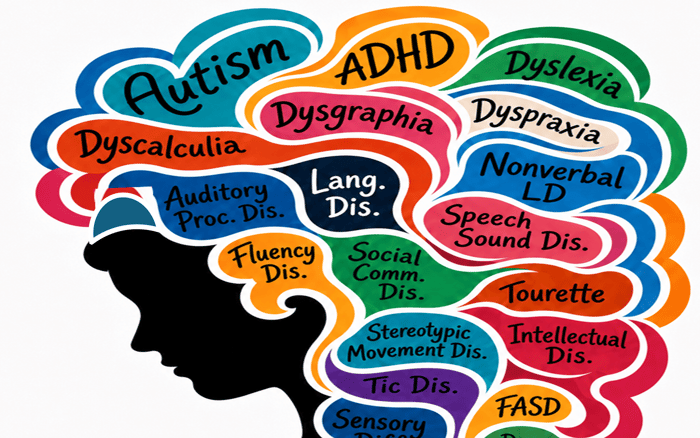
Investor Personality & Fiduciary Practices IAR CE offers practical steps fiduciaries can apply with clients. The class applies knowledge derived from Financial Advising Neurodivergence (NASAA Course ID C82066) by Frank Murtha, Ph.D., founder of Financial Counseling Institute. Based on concepts taughtat that webinar, Dr. Murtha collaborated with A4A Editor Andrew Gluck to craft a document optimized for CE.
This class is delivered in a highly formatted PDF created expressly for CE. It's skimmable information easily consumed by reading. Although content is related to an earlier class, the practice-oriented analysis is new information. This allows practitioners to go deeper on a topic they care about. Read the first two practice actions to consider in advising individuals affected by ADHD and autism here.
The fastest way to pass IAR CE quizzes
The fastest way to get IAR CE credits is to learn the material well enough to pass the assessment on the first attempt. A typical self-study course usually includes a 10-question multiple-choice quiz, often requiring a 70% passing score and three interactive exercises. The assessment should not merely reward searching for matching words. It should test whether the adviser understands the learning objectives. When the reading assignment is well designed for IAR CE and the quiz is fair, an adviser saves time by learning once instead of repeatedly guessing or searching. An adviser experiences learning!
How self-study supports fiduciary application
Self-study can be especially useful when the course translates regulatory, behavioral, or planning concepts into practice steps. Advisors do not merely need abstract knowledge. They need to know what to say to clients, how to document understanding, when to slow a recommendation, and how to make implementation easier. The fastest way to get IAR CE credits should therefore also be a productive way to strengthen practice. Courses that connect analysis, exercises, and quiz questions help advisers turn CE from a requirement into a usable professional process.
Choosing the fastest way to get IAR CE credits wisely
The fastest way to get IAR CE credits is a well-designed self-study course that respects both the adviser’s time and the purpose of professional education. Reading lessons can be efficient, but only when they are structured, substantive, and tied to assessment. A course built from transcript, analysis, quiz, and exercises can preserve integrity while reducing wasted time. For advisers, the practical test is simple: does the course help you meet the requirement and improve how you serve clients? If it does both, self-study is likely to be the most efficient CE format available.
FAQ:
What is the fastest way to get IAR CE credits?
The fastest way to get IAR CE credits is usually a structured self-study course with reading lessons, exercises, and a quiz.
Can IAR CE credits be earned by reading?
Yes. Reading-based self-study can support IAR CE credit when the course is properly designed, approved, assessed, and documented.
Does reading count the same as watching a webinar?
Reading can count when the course meets applicable instructional-time, learning objective, assessment, and completion requirements.
Is the fastest way to get IAR CE credits always self-study?
For many advisers, yes, because self-study removes scheduling delays. It let's you decide when to read the lesson, what to focus on, and does not force you to listen to a continual stream of audio pocked by "um" and "uhs." Live webinars may still be preferable for interaction, however
What is the 9,600-word guideline?
It is a common instructional-design convention used by some providers to approximate about 50 minutes of reading time.
Is 9,600 words an official NASAA rule?
It should not be described as an official NASAA rule unless directly stated by the applicable controlling authority. NASBA, CFP Board, and other professional education governing bodies also rely on the 9,600 word guideline.
Why does one CE credit often equal 50 minutes?
Many financial planning and investment adviser representative professional education systems use approximately 50 minutes of instruction as the basis for one credit hour.
Can advisers speed up CE by reading faster?
Some advisers may read more efficiently than others, but credit must be based on completing the approved course materials and required assessment.
Do self-study IAR CE courses require a quiz?
Yes. Self-study for IARs, financial advice and planning professionals requires an assessment that verifies learning tied to the course objectives.
Are open-book IAR CE exams allowed?
Some providers use open-book formats, but stronger courses test applied understanding rather than simple keyword lookup.
Why do open-book exams weaken learning?
They can reward searching for answers instead of understanding how course concepts apply in advisory practice.
Why add analysis to a webinar transcript?
Analysis explains how advisers might apply the instructor’s ideas in client meetings, documentation, and follow-through.
Is analysis duplicative of a transcript?
No, not when it adds new explanations, practice guidance, examples, and implementation steps.
Can analysis shorter than the transcript add CE credit?
Yes, if it is substantive, non-duplicative, and part of a documented instructional design supporting the credit. This approach allows IARs a deeper learning experience, ways to learn more about financial planning specialties.
Does self-study IAR CE help fiduciary practice?
It can, especially when lessons focus on client understanding, communication, risk explanation, and implementation.
What should advisers look for in self-study CE?
Look for clear lessons, learning objectives, practical application, fair assessments, and documented completion.
Can self-study IAR CE also count for CFP, CIMA, CPA, PFS, CFA credit?
It may. A4A submits classes for approval to CFP Board, IWI, NASBA, and NASAA. and classes are generally accepted CE by CFA Institute.
What is the best self-study IAR CE format?
The best format combines concise reading, applied analysis, exercises, and a quiz tied to the learning objectives.
FAQs
How do I choose between self-study and live IAR CE?
Choose self-study for flexibility and speed. Choose live courses if you value interaction or structured pacing.
What makes a self-study IAR CE course efficient?
Clear writing, focused lessons, aligned quizzes, and minimal redundancy improve completion speed.
Can poorly designed courses slow down IAR CE completion?
Yes. Disorganized content and unclear assessments increase time spent rereading or guessing answers.
Is reading faster than watching a webinar for CE credit?
Often yes, because reading allows skipping familiar material and revisiting key sections quickly.
How can advisers avoid retaking IAR CE quizzes?
By understanding learning objectives first and reviewing key sections before attempting the quiz.
What role do learning objectives play in faster completion?
They guide attention to tested concepts, reducing unnecessary reading and improving quiz performance.
Should advisers take notes during self-study IAR CE?
Brief notes can improve retention and reduce time spent rechecking material during assessments.
How do applied exercises improve CE efficiency?
They reinforce understanding before the quiz, reducing trial-and-error during assessment attempts.
Are shorter courses always faster for IAR CE credit?
Not necessarily. Poorly structured short courses can take longer than clear, well-designed lessons.
How can advisers verify a course is worth their time?
Review course structure, objectives, format, and whether it emphasizes practical application.
Does course format affect long-term retention?
Yes. Structured reading and applied analysis often improve retention compared to passive viewing.
Can self-study IAR CE fit into short work sessions?
Yes. Reading-based formats allow progress in short intervals without losing continuity.
What is the risk of focusing only on speed?
Superficial learning may reduce effectiveness in client communication and decision-making.
How does better course design reduce total CE time?
It eliminates unnecessary content and aligns learning directly with assessment requirements.
Can self-study IAR CE improve client outcomes?
It can when lessons translate concepts into clear communication and implementation steps.