
Table of Contents
- 2026 Market Conditions Raise the Stakes
- Professional Responsibility vs. Ethics: Why the Distinction Matters
- Strategic Emotional Communication and the Adviser’s Role
- Four Leverage Points Advisors Can Control
- Fearful Headlines vs. Market Reality
- Processing Fluency: Why Repetition Changes Belief
- Emotional Encoding and Memory Retention
- A 12-Class LIVE 2026 IAR CE Plan With Rave Reviews
- Completing 2026 IAR CE Without December Pressure
- Communication Skills Central To Advisor Value
- FAQs
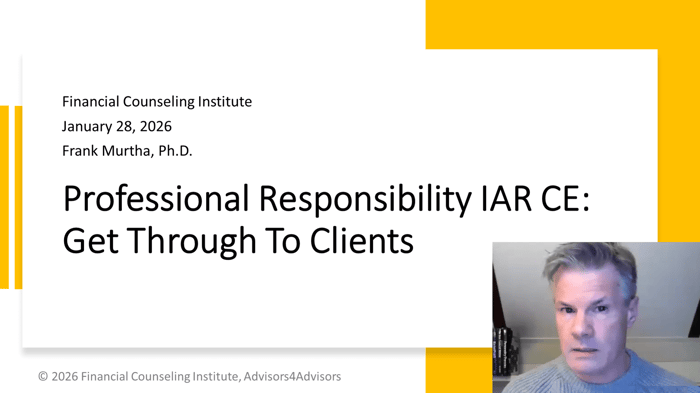
Financial professionals enter 2026 facing an unusual environment. Markets are always uncertain but news seems emotionally charged more often. Clients are being influenced by repeated narratives that have little connection to long-term outcomes. Clients exposed repeatedly to emotionally charged news are empirically proven to be more likely to internalize those messages as credible due to processing fluency and repetition effects. Research shows short-term news, geopolitical events, and media sentiment have limited correlation with long-term investment performance but strong influence on investor behavior. In this environment, technical expertise is not enough. The crucial skill for advisors in current financial economic conditions is the ability to deliver insights in ways clients are more likely to hear, process, remember, and act on. That is the focus of Dr. Frank Murtha’s live session, Professional Responsibility IAR CE: Get Through To Clients. To be clear, communication skills training should be centerstage in a well-designed live 2026 IAR CE plan.
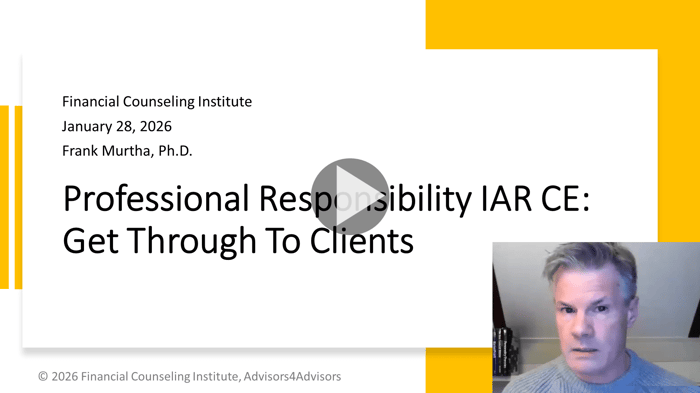
Here's a sample of the class and transcript.
2026 Market Conditions Raise the Stakes
(live 2026 IAR CE plan)
Dr. Murtha, who earned a Ph.D. in Counseling Psychology by pioneering research in behavioral finance on a gambler's mentality, begins the class by anchoring the discussion in current market sentiment. Entering 2026, forecasters show near unanimity about market direction. Up! At the same time, investors are confronted with persistent inflation concerns, geopolitical instability, civil unrest, and policy uncertainty. Clients do not experience these issues separately. They absorb them emotionally, often through social media and repeated headlines.
This poses a problem for advisors that they may not even know exists: When anxiety is elevated, client receptivity drops. Even a well-constructed plan can fail if delivered when clients are cognitively overloaded or emotionally defensive. This reality is why communication competence is no longer a “soft skill,” but a core professional responsibility directly as part of any live 2026 IAR CE plan.
Professional Responsibility vs. Ethics: Why the Distinction Matters
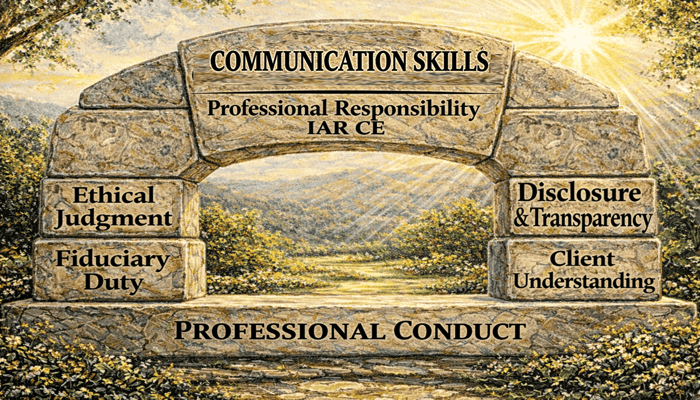
Under the NASAA IAR CE framework, Ethics and Professional Responsibility serve different purposes. Ethics courses focus on fiduciary duty, conflicts of interest, disclosure obligations, and client-first standards. Professional Responsibility courses, by contrast, address how advisers apply judgment in practice, including communication, counseling, and client decision-making under stress.
Murtha’s session squarely fits within 2026 Professional Responsibility IAR CE. The course does not debate ethical principles; it teaches advisors how to deliver advice responsibly when emotions, fear, and cognitive bias interfere with rational decision-making. This distinction is important for advisors searching for a live 2026 IAR CE plan that meets category requirements efficiently without diluting educational value or delivering dumbed-down content. .
Strategic Emotional Communication and the Adviser’s Role
(live 2026 IAR CE plan)
A central theme of the session is strategic emotional communication. Advisers often move too quickly from empathy to recommendations, assuming insight alone creates value. Murtha argues that this approach fails when clients are emotionally dysregulated.
Strategic emotional communication means sequencing conversations so clients are psychologically prepared to receive guidance. It requires recognizing emotional cues, slowing the pace of advice delivery, and framing information in ways that reduce resistance rather than provoke it. These skills directly affect outcomes, which is why they belong in a live 2026 IAR CE plan focused on real-world client interactions rather than abstract theory.
Four Leverage Points Advisors Can Control
Murtha introduces four practical leverage points that determine whether insight lands or fails:
Receptivity – Is the client emotionally open to hearing advice?
Perception – How is the message framed and interpreted?
Impact – What does the client remember after the meeting ends?
Social Proof – How perceived norms influence acceptance.
None of these require changes to asset allocation or financial planning software. They are communication choices advisers make every day. Professional Responsibility CE exists precisely to sharpen this judgment, reinforcing why communication-focused courses are essential components of a live 2026 IAR CE plan.
Fearful Headlines vs. Market Reality
(live 2026 IAR CE plan)
Dr. Murtha walks through several historical examples showing how emotionally charged events often fail to produce lasting market damage. He cites the October 2023 rate spike, the 2020 civil unrest period, and the 2025 Iran nuclear strike headlines. In each case, fear was intense, yet market outcomes were far more resilient than investor reactions suggested.
Clients rarely remember these historical patterns when fear is present. Advisors, however, have a professional responsibility to provide context without dismissing emotion. This balancing act—acknowledging fear while preventing rash decisions—is a core competency developed through a well-structured live 2026 IAR CE plan.
Processing Fluency: Why Repetition Changes Belief
One of the intriguing actionable insights in the session is called processing fluency. Dr. Murtha explains that repeated messages become easier for the brain to process, and familiarity is often mistaken for truth. Importantly, belief accelerates most strongly on the second exposure to a message. To be clear,
In today’s media environment, clients are likely to encounter alarming narratives about what's about to happen that will forever change the world multiple times before speaking with you. Understanding processing fluency allows you to proactively counterbalance external messaging rather than react defensively. This is not persuasion; it is informed fiduciary communication, appropriately placed at centerstage within a professional responsibility education in a live 2026 IAR CE plan.
Emotional Encoding and Memory Retention
Another actionable communication tips Dr. Murtha provides: Emotionally charged information is encoded more deeply in memory. From an evolutionary perspective, this helped humans survive threats. In markets, it means fear-based narratives crowd out rational explanations.
Dr. Murtha emphasizes that advisors must intentionally attach emotional salience to stabilizing messages if they want those messages to endure beyond the meeting. Otherwise, fear dominates recall. Advisors can attach emotional salience to stabilizing messages by:
- pairing factual guidance with personally meaningful client goals, such as retirement security or family stability, rather than presenting data in isolation.
- reinforcing the message through clear repetition and simple framing during the meeting increases recall after clients leave.
- ending with a concise takeaway tied to the client’s stated priorities helps the message persist beyond the immediate emotional moment.
This insight reinforces why communication skills directly influence client outcomes and why Professional Responsibility CE plays a central role in a live 2026 IAR CE plan.
A 12-Class LIVE 2026 IAR CE Plan With Rave Reviews
This class is part of a 12-class LIVE 2026 IAR CE plan designed to help investment adviser representatives complete annual NASAA IAR CE requirements through paced, interactive instruction. Instructors include independent economist Fritz Meyer, A4A Editor Andrew Gluck and Craig Turner, an artificial intelligence consultant to Chambers of Commerce and their members.
The live 2026 IAR CE plan delivers a complete solution across Ethics, Professional Responsibility, and Products & Practice through scheduled live classes. There are no final exams, no passing scores or year-end rush. Participation is measured through live attendance and polling, creating a learning experience that is applicable daily, lowers stress, and actually enjoyable.
12-Class LIVE 2026 IAR CE Course Schedule
| Live Class | Instructor | Date | IAR CE Category |
|---|---|---|---|
| Financial Economic Update | Fritz Meyer | Jan 13, 2026 | Products & Practice |
| Best Practices in Financial Counseling | Frank Murtha | Jan 28, 2026 | Professional Responsibility |
| Financial Economic Update | Fritz Meyer | Feb 17, 2026 | Products & Practice |
| NASAA Preemption Risk Explained | Andrew Gluck | Feb 25, 2026 | Ethics |
| DC Regulatory Update | Michael Canning | Mar 3, 2026 | Ethics |
| 10 ChatGPT Prompts for 2026 IAR CE | Craig Turner | Mar 11, 2026 | Professional Responsibility |
| Financial Counseling | Frank Murtha | Apr 8, 2026 | Professional Responsibility |
| NASAA Regulatory Update | Andrew Gluck | May 12, 2026 | Ethics |
| AI, ChatGPT & IAR CE: Practical Prompts | Craig Turner | Jun 17, 2026 | Professional Responsibility |
Each live class addresses timely regulatory, economic, ethics, or professional responsibility issues advisors face in practice. Together, the 12 live classes provide a structured path to staying compliant, informed, and client-focused throughout 2026.
Completing 2026 IAR CE Without December Pressure
The plan enables IARs to complete NASAA IAR CE requirements over either the first and second half of 2026 in two six-month cycles. The structure allows advisers to focus on clients rather than CE logistics while remaining current on ethics, professional responsibility, and market developments. Learning objectives are distributed to Advisors4Advisors members prior to each class.
Communication Skills Central To Advisor Value
In current financial economic conditions, the role of advisors increasingly centers on translation—turning chaos into clarity. Dr. Murtha’s 52 minute class makes clear that insight must be delivered in a way clients can receive, remember, and trust and shows you how to do it. That reality explains why communication skills now sits at the center of Advisors4Advisors live 2026 IAR CE plan.
FAQs
Is this class Ethics IAR CE or Professional Responsibility IAR CE?
This class is categorized as Professional Responsibility IAR CE because it focuses on how you communicate advice, exercise judgment, and manage client decision-making under emotional stress rather than on fiduciary rules or conflicts of interest.
Why does communication skills training qualify as Professional Responsibility CE?
Professional Responsibility CE addresses how you apply professional judgment in practice, including counseling skills, client communication, and behavioral decision-making. This course teaches how message delivery affects client outcomes, which fits squarely within that scope.
Why are communication skills emphasized in a live 2026 IAR CE plan?
In current market conditions, clients are heavily influenced by repeated emotional narratives. A live 2026 IAR CE plan prioritizes communication skills because poor message delivery—not poor advice—is often what leads to client mistakes.
What makes this class different from traditional behavioral finance courses?
Traditional behavioral finance often explains biases but stops short of showing how to change behavior. This class focuses on practical techniques you can use in real client conversations to improve understanding, retention, and follow-through.
Why is live instruction important for Professional Responsibility IAR CE?
Live instruction allows you to engage with real-time examples, interactive polling, and practical scenarios that reflect how clients actually behave. These skills are more effectively learned live than through passive, on-demand formats.
How does this class help with anxious or fearful clients?
The course explains how anxiety reduces receptivity and why repeated headlines can distort perception. You learn how to structure conversations so clients are emotionally prepared to hear stabilizing guidance.
What is processing fluency and why does it matter for client communication?
Processing fluency refers to the tendency to believe information more readily when it is repeated or familiar. Understanding this helps you counteract misleading narratives clients encounter before they ever meet with you.
How do you make stabilizing messages stick after the meeting ends?
The class shows how to attach emotional salience to sound advice by tying guidance to personal client goals, reinforcing key points through repetition, and ending meetings with clear, memorable takeaways.
Is this class part of a larger live 2026 IAR CE plan?
Yes. This course is one component of a 12-class live 2026 IAR CE plan that covers Ethics, Professional Responsibility, and Products & Practice through scheduled live instruction.
Can you complete all 2026 NASAA IAR CE requirements through this live plan?
The 12-class live 2026 IAR CE plan is structured to allow completion of annual NASAA IAR CE requirements through live classes delivered across the year, rather than waiting until December.
Are there exams or passing scores?
No. Participation is based on live attendance and engagement through polling, making the learning experience lower stress and more practical.
Who should consider this live 2026 IAR CE plan?
This plan is designed for IARs, CFP® professionals, CPAs, CIMAs, and other financial professionals who want structured, live education that strengthens real-world client communication while meeting CE requirements efficiently.