
Table of Contents
- Why Make Professional Responsibility IAR CE On Client Communications?
- The Chaotic Backdrop Facing Clients in Early 2026
- Why Fear Persists Even When Markets Perform Well
- What Comes Before Professional Responsibility IAR CE On Client Communications
- How Framing Shapes Client Perception and Decision-Making
- Why Numbers Alone Rarely Persuade Clients
- Maximizing Impact Through Anchors and Focus
- Using Social Proof Responsibly in Client Conversations
- A 12 Class LIVE 2026 IAR CE Fulfillment Plan
- 12-Class LIVE 2026 IAR CE Course
- What This Class Ultimately Teaches Financial Advisors
- FAQs
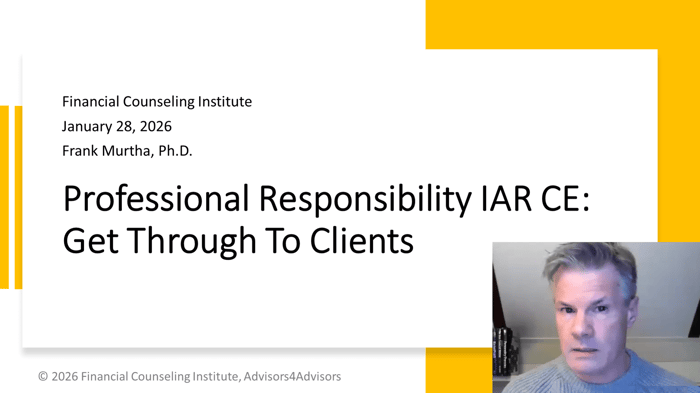
In volatile and emotionally charged markets, professional responsibility IAR CE on client communications is a core course. Advisors are expected to translate complexity into clarity and deliver guidance clients can use without panic or confusion in the most stressful moments of their lives. This class, Getting Through to Clients: Maximizing Your Message, focuses on how advisors meet that responsibility in real client conversations. Rather than emphasizing technical knowledge alone, the course examines how communication failures arise and how they can be prevented through disciplined, repeatable practices. The result is a 51-minute IAR CE class that neatly offers a practical framework advisors can apply immediately to improve financial planning outcomes and strengthen client trust.
Why Make Professional Responsibility IAR CE On Client Communications?
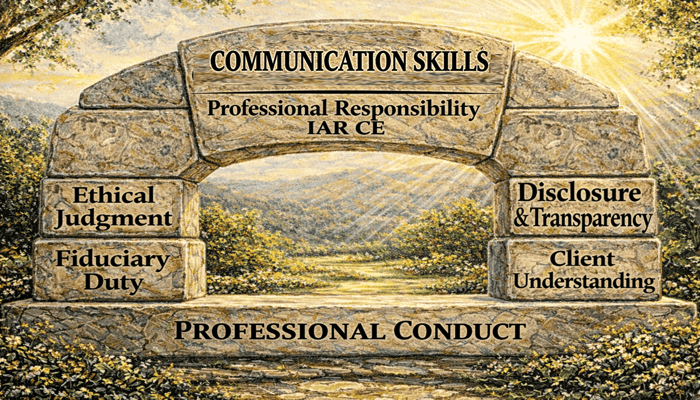
Professional responsibility IAR CE on client communications sit at the center of professional conduct because advice only works if it's understood and accepted. Advisors rarely fail due to lack of knowledge; they fail when insights are delivered at the wrong moment or in the wrong way. This class begins from the premise that advisors often say the right thing before clients are ready to hear it. Professional responsibility therefore includes timing, tone, and emotional awareness—not just accuracy. By treating communication as a professional process rather than a personality trait, the course reframes client resistance as a solvable practice issue. Advisors who adopt this mindset are better equipped to fulfill their obligations consistently.
The Chaotic Backdrop Facing Clients in Early 2026
The course grounds professional responsibility IAR CE on client communications in the reality clients are facing in early 2026. Geopolitical tension, inflation uncertainty, and mass media shape how clients perceive their investments. In addition. clients do not compartmentalize markets from life's other stresses. Advisors who ignore this context risk misinterpreting client reactions as irrational rather than predictable. Professional responsibility demands situational awareness, which is why Frank Murtha, who holds a Ph.D. in counseling psychology, emphasizes that effective communication begins with understanding the emotional environment clients are navigating as well as other life changes they're experiencing now.
Why Fear Persists Even When Markets Perform Well
Through historical examples, the instructor demonstrates why fear often persists despite positive market outcomes. Events such as the Treasury Tantrum, periods of civil unrest, and geopolitical shocks are reviewed alongside market performance data. The lesson is not that risk disappears, but that perception routinely overwhelms evidence.
According to Dr Murtha, professional responsibility IAR CE on client communications must reinforce how humans are wired to react to fear through repetition, vivid imagery, and recency. When advisors fail to counter these forces with context, clients are more likely to abandon a long-term plan. This section reinforces the advisor’s professional role as a stabilizing presence during periods of heightened uncertainty.
What Comes Before Professional Responsibility IAR CE On Client Communications
A core lesson of the class is that advice cannot be effective without emotional receptivity. The instructor revisits counseling principles summarized by CURE—caring, understanding, respect, and empathy—as practical tools for professional conversations. These are not therapeutic techniques, but foundational to professional responsibility IAR CE on client communications and open a window for influence. Advisors are shown how premature problem-solving creates resistance, even when recommendations are sound. From a professional responsibility standpoint, establishing receptivity is a duty that precedes analysis and solutions. Skipping this step increases misunderstanding and weakens the advisor-client relationship.
How Framing Shapes Client Perception and Decision-Making
The course next turns to perception, emphasizing that all evaluations are relative and all choices depend on framing. Through visual demonstrations and numerical examples, advisors see how identical data can appear radically different depending on context. Clients do not extract meaning from numbers automatically. Financial advisor communications require advisors to actively construct that meaning through comparison and explanation. Presenting data neutrally often leaves clients confused or misled. This section of the professional responsibility IAR CE on client communications reinforces why framing is a professional responsibility: advisors shape how clients understand risk, opportunity, and tradeoffs.
Why Numbers Alone Rarely Persuade Clients
Advisors often assume that percentages, averages, and projections speak for themselves. This professional responsibility IAR CE on client communications challenges this assumption by showing how clients struggle with abstract figures. Financial advisor communications improve dramatically when numbers are translated into totals, multiples, and real-life consequences. This is not exaggeration; it is relevance. Professional responsibility includes ensuring clients grasp what decisions actually mean for their lives. By connecting numbers to outcomes clients care about, advisors reduce confusion, regret, and disengagement.
Maximizing Impact Through Anchors and Focus
Even when clients are receptive and information is well framed, attention remains limited. Dr. Murtha explains how anchoring, verbal cues, and timing help advisors highlight what truly matters. Clients remember beginnings and endings disproportionately, making structure a professional tool. Effective financial advisor communications involve deciding what clients must remember after the meeting ends. Advisors who manage attention responsibly improve retention and decision quality. This professional responsibility IAR CE on client communications that emphasizes prioritization as a professional obligation, not a presentation trick.
Using Social Proof Responsibly in Client Conversations
Social proof is introduced as a powerful but easily misused influence. Clients naturally look to others for validation when uncertainty is high. The class shows how financial advisor communications can incorporate norms and success stories without pressuring clients or undermining autonomy. Used responsibly, social proof reassures rather than coerces. Professional responsibility is maintained by preserving client choice while explaining why certain approaches are widely adopted. This balance protects trust while supporting informed decisions.
A 12 Class LIVE 2026 IAR CE Fulfillment Plan
This class is part of a 12-live class series. It is the best way to meet 2026 IAR CE requirements in an all-LIVE 12 class plan. This 12-class LIVE plan delivers a complete 2026 NASAA IAR CE solution at a paced schedule of live continuing education. No assessments, no passing scores. Live participation in polls for IARs and CPAs. Stress free and enjoyable learning.
12-Class LIVE 2026 IAR CE Course | |||
|---|---|---|---|
| Live Class | Instructor | Date | IAR CE Category |
| Legend: Ethics Professional Responsibility Products & Practice | |||
| Financial Economic Update | Fritz Meyer | Tuesday, January 13, 2026 | Products & Practice |
| Best Practices in Financial Counseling | Frank Murtha | Wednesday, January 28, 2026 | Professional Responsibility |
| Financial Economic Update | Fritz Meyer | Tuesday, February 17, 2026 | Products & Practice |
| NASAA Preemption Risk Explained | Andrew Gluck | February 25, 2026 | Ethics |
| DC Regulatory Update | Michael Canning | Tuesday, March 3, 2026 | Ethics |
| 10 ChatGPT Prompts for 2026 IAR CE | Craig Turner | Wednesday, March 11, 2026 | Professional Responsibility |
| Financial Economic Update | Fritz Meyer | Thursday, March 12, 2026 | Products & Practice |
| Financial Counseling | Frank Murtha | Wednesday, April 8, 2026 | Professional Responsibility |
| Financial Economic Update | Fritz Meyer | Tuesday, April 21, 2026 | Products & Practice |
| NASAA Regulatory Update | Andrew Gluck | Tuesday, May 12, 2026 | Ethics |
| Financial Economic Update | Fritz Meyer | Tuesday, May 26, 2026 | Products & Practice |
| AI, ChatGPT & IAR CE: Practical Prompts | Craig Turner | Wednesday, June 17, 2026 | Professional Responsibility |
| Post-FOMC Financial Economic Update | Fritz Meyer | Tuesday, June 23, 2026 | Products & Practice |
| Complete your 12-Class LIVE 2026 IAR CE efficiently. Reserve your seat in the full live program and stay current on ethics, professional responsibility, and products & practice throughout 2026. View Program Details & Register | |||
Each live class addresses timely regulatory, economic, ethics, and professional responsibility issues advisors face in practice. The LIVE IAR CE Course emphasizes real-world application, expert instruction, and interactive learning—without exams or waiting until December to complete the annual NASAA IAR CE requirements. Together, the 12 live classes provide a structured path to staying compliant, informed, and client-focused in 2026 and beyond.
This class is part of a IAR CE plan enabling IARs to complete 2026 NASAA IAR CE requirements in 12 live classes twice a year in two six month periods. The learning objectives for the class will be emailed to members of A4A ($70/qtr.) before the class. The plan enables completion of 2026 IAR CE requirements over the first or second half of 2026.
What This Class Ultimately Teaches Financial Advisors
This is professional responsibility IAR CE on client communications that concludes by reinforcing that financial advice is not an abstract optimization exercise. All financial decisions are attempts to meet real-life goals under uncertainty. Financial advisor communication skills determine whether expertise actually benefits clients. Professional responsibility requires advisors to manage emotions, perception, and attention as carefully as data. By integrating counseling principles with disciplined communication techniques, advisors strengthen trust and improve outcomes. This class equips professionals to deliver insights clients can hear, understand, and responsibly act upon.
FAQs
What is professional responsibility IAR CE on client communications?
Professional responsibility IAR CE on client communications focuses on how investment adviser representatives deliver advice in real client interactions. Rather than teaching technical investment concepts, this category of IAR CE addresses communication duties, emotional awareness, and process discipline required to help clients understand and act on guidance responsibly.
Why does client communication qualify as Professional Responsibility IAR CE?
Client communication qualifies as Professional Responsibility IAR CE because advice only works if it is understood and accepted. Advisors have a professional obligation to manage timing, tone, framing, and emotional context when communicating with clients, especially during periods of market stress or uncertainty.
How does this class differ from traditional ethics IAR CE?
Unlike purely values-based ethics courses, professional responsibility IAR CE on client communications focuses on advisor conduct and communication process. On Advisors4Advisors, Professional Responsibility IAR CE is presented alongside
Ethics IAR CE courses because both categories address how advisors act in client-facing situations rather than what products they recommend.
Who should take this professional responsibility IAR CE on client communications course?
This course is designed for state-registered IARs, RIA owners, and financial advisors who regularly guide clients through volatile or emotionally charged market conditions. It is especially valuable for advisors completing a structured live CE schedule such as the
12-Class LIVE 2026 IAR CE plan.
What practical skills does this class teach advisors?
The class teaches advisors how to establish emotional receptivity, frame information effectively, translate numbers into real-life meaning, manage attention, and use social proof responsibly. These communication skills complement technical knowledge gained in
Products & Practice IAR CE courses by ensuring advice is actually understood and applied.
How long is the professional responsibility IAR CE on client communications class?
This professional responsibility IAR CE on client communications course runs approximately 51 minutes. It is designed to fit cleanly into a live CE schedule without exams or unnecessary assessments, making it easy to complete as part of a broader IAR CE plan.
Does this class help advisors during market volatility?
Yes. A core focus of the course is helping advisors communicate effectively during periods of volatility, uncertainty, and heightened fear. The class explains why clients react emotionally to headlines and how advisors can counter those reactions with context, structure, and disciplined communication.
Is this class part of a larger 2026 IAR CE plan?
Yes. This professional responsibility IAR CE on client communications class is one component of the
12-Class LIVE 2026 IAR CE plan, which allows IARs to complete NASAA IAR CE requirements through paced, live instruction across the year.
Will this class improve client trust and long-term outcomes?
The class is designed to strengthen trust by reducing misunderstanding, panic, and disengagement. By improving how advice is delivered—not just what advice is given—advisors are better positioned to support informed decisions and long-term financial planning outcomes.