
Table of Contents
- Professional Responsibility Is Not Abstract—It Happens in Conversation
- What's In This Professional Responsibility IAR CE Class
- Why Effective Communications Is a Fiduciary Obligation
- Persuasion—Taught for the Right Reasons
- A Moment of Candor That Resonated
- Dr. Murtha Represents A4A's Value
- What Advisors Take Back Into Client Meetings
- Why This Matters for 2026 NASAA IAR CE
- FAQs
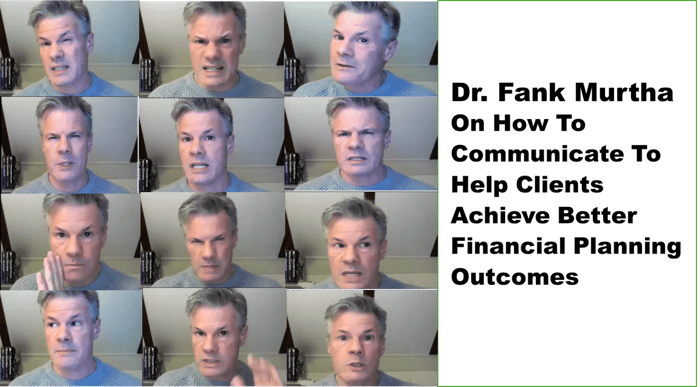
If you look closely at the image above, you don’t just see a speaker mid-sentence. You see intensity, concern, curiosity, frustration, and conviction—sometimes all at once. Those expressions capture something essential about Advisors4Advisors (A4A) instructors: they teach weighty subjects with real emotional engagement because they believe the work actually matters. That difference is especially visible in the work of Frank Murtha, Ph.D., whose latest class shows why Professional Responsibility IAR CE on client communications has become one of the most consequential areas of advisor education heading into 2026. This is not about checking a CE box. It’s about whether clients can truly hear fiduciary advice when fear, emotional headlines, and uncertainty are influencing them every day and competing with you for their attention..
Professional Responsibility Is Not Abstract—It Happens in Conversation
Professional Responsibility and Ethics are often thought of as abstract obligations. Advisors are taught what must be disclosed, what must be avoided, and how to document decisions for regulators.
His class begins with a reality every experienced advisor recognizes: Most client mistakes do not happen because advisors lack technical knowledge. They happen because clients are emotionally overwhelmed at the precise moment advice is delivered. Anxiety, overconfidence, political polarization, and nonstop news exposure distort how information is processed—often without the client realizing it.
2026 professional responsibility IAR CE on client communications, as a result is no longer a secondary topic or a “soft skill.” It is a core fiduciary competency on Advisors4Advisors. If clients misunderstand advice—or cannot act on it because emotional interference overwhelms comprehension—the duty to act in the client’s best interest has not been fully realized, even if the advice itself is technically sound.
What's In This Professional Responsibility IAR CE Class
Dr. Murtha’s latest IAR CE class is not a lecture on theory. It is a practical examination of how advisors communicate insight when clients are least prepared to receive it. The class walks through:
how emotionally charged environments reduce client receptivity before logic ever enters the conversation
why repetition and vivid news coverage amplify perceived risk through availability bias
how subtle language choices unintentionally trigger defensiveness
and how advisors can structure conversations so insight lands, sticks, and guides behavior
This is Professional Responsibility IAR CE on client communications grounded in psychology and lived advisory experience, not motivational slogans.
Frank shows advisors how to deliver guidance when clients are tempted to abandon long-term plans—not by talking louder, simplifying charts, or reassuring reflexively, but by understanding how human beings process fear, uncertainty, and social pressure.
However, Dr. Frank Murtha's facial expressions, captured by his video camera, automatically propels this to the top of the list of the best IAR professional responsibility CE of 2026. Below are 10 things you can learn from this on-demand class.
Learn to:
|
Why Effective Communications Is a Fiduciary Obligation
One of the most important through-lines in Frank’s class is the idea that fiduciary duty does not end with giving advice. It extends to ensuring advice is actually understood.
In emotionally neutral conditions, clients may process information rationally. In emotionally charged conditions, they often cannot. That distinction matters. Professional Responsibility requires advisors to account for foreseeable risks to client decision-making—including emotional and cognitive ones.
This is where Professional Responsibility IAR CE on client communications earns its classification. Frank is not teaching advisors how to persuade clients to do what the advisor wants. He is teaching advisors how to protect clients from making decisions that contradict their own long-term goals under emotional pressure.
When communication fails, harm becomes more likely. When communication succeeds, fiduciary intent is reflected in client outcomes.
Persuasion—Taught for the Right Reasons
Frank is unusually, well, frank, about persuasion. He does not pretend that framing, timing, and contrast are irrelevant to financial decisions. He acknowledges openly that these tools have long been used by sales professionals.
The difference is purpose.
Frank teaches persuasion because he trusts the A4A audience. Advisors who join A4A are not looking for shortcuts or scripts. They accept that client-first responsibility sometimes requires helping clients resist their own worst instincts during moments of fear or excitement.
That is why persuasion, in this context, is not manipulation. It is protection.
To be clear, when techniques like this are put before in front of financial advisors, it's historically been to show them how to sell financial products.
Used responsibly, however, Dr. Murtha keeps clients aligned with plans they already agreed serve their best interests. This is precisely why persuasion belongs inside Professional Responsibility IAR CE on client communications, not outside it.
A Moment of Candor That Resonated
Frank does not discuss politics in his classes. His instruction is disciplined, evidence-based, and focused squarely on client behavior.
Which is why one moment in this latest class stood out.
While explaining how emotionally charged narratives distort decision-making, Frank referenced political polarization—not to argue ideology, but to illustrate how constant conflict framing increases anxiety, short-term thinking, and risk misperception.
It resonated precisely because it was not partisan.
The point was not what people believe. The point was how emotional intensity and repetition—regardless of source—can push clients toward poor financial decisions. That observation reinforced the central case for Professional Responsibility IAR CE on client communications: advisors must account for the emotional environment clients live in, not just the portfolios they hold.
Dr. Murtha Represents A4A's Value
Frank’s approach is a hallmark of the Advisors4Advisors brand since . It is representative.
Fritz Meyer, approaching his sixteenth anniversary teaching advisors, brings the same seriousness to helping professionals interpret markets without amplifying fear or false certainty. His classes consistently emphasize judgment over prediction.
Craig Turner has taught more than 2,500 organizations how to apply artificial intelligence responsibly. His focus is not hype, but disciplined use—helping advisors avoid technological shortcuts that undermine trust and professional judgment. He advises Chambers of Commerce and has been serving as interim executive director at the Niagara, N.Y. Chamber.
Different subject matter. Same ethos since our first webinar in October 2008.
A4A instructors do not teach to impress. They teach because they are thought leaders passionate about their work.
What Advisors Take Back Into Client Meetings
Advisors who attend Frank’s class might experience subtle but meaningful changes in how they conduct meetings. You may:
slow down key moments instead of rushing through them
listen longer before offering solutions
frame choices in ways clients can actually process
and focus less on being “right” and more on being effective
These changes are not cosmetic. They directly affect client behavior. Clients feel understood, become less defensive, and are more likely to stay disciplined when emotions run high.
That is the practical payoff of A4A Professional Responsibility IAR CE on client communications.
Why This Matters for 2026 NASAA IAR CE
The NASAA IAR CE model rule establishes a minimum educational standard. Dr. Murtha's class, in an environment defined by emotionally charged headlines, persistent uncertainty, and rapid narrative shifts, demonstrate that communication skills are no longer ancillary to fiduciary duty but central to it.
Advisors who can translate insight into understanding—and understanding into disciplined action—are better positioned to fulfill their professional responsibility to clients in 2026. Dr Murtha’s communications class is built for exactly that challenge.
Here's more Ethics and Professional Responsibility IAR CE like this class.
FAQs
Does this course qualify as Professional Responsibility IAR CE?
Yes. The course focuses on how advisors communicate fiduciary guidance to clients, particularly during emotionally charged decision-making situations. That emphasis supports classification as Professional Responsibility IAR CE on client communications, subject to sponsor approval and NASAA standards.
Why is client communication considered a Professional Responsibility topic?
Because fiduciary duty is not satisfied if advice is technically correct but misunderstood, ignored, or overridden by emotion. Client communication directly affects whether advice can be acted on in the client’s best interest.
Is this course about sales techniques or marketing persuasion?
No. The course does not teach product sales, marketing tactics, or influence for personal gain. Communication techniques are taught solely to help advisors protect clients from emotionally driven decisions that conflict with their long-term goals.
How is this different from a typical behavioral finance course?
Behavioral finance often explains why clients behave irrationally. This course focuses on what advisors can do—in real conversations—to help clients process information, reduce defensiveness, and stay aligned with fiduciary guidance.
Does the course address current events or political issues?
The course does not advocate political positions. Current events are discussed only to the extent they create emotional pressure that can distort financial decision-making and client risk perception.
What practical skills do advisors gain from this course?
Advisors learn how to structure conversations, choose language carefully, manage emotionally charged discussions, and present insights in ways clients are more likely to hear, remember, and act on responsibly.
Who is this course most appropriate for?
This course is designed for state-registered IARs and other advisors who want to strengthen fiduciary communication skills, particularly when clients are anxious, overconfident, or influenced by emotionally charged narratives.
Why is this topic especially relevant for 2026 IAR CE?
Market uncertainty, persistent news cycles, and heightened emotional narratives increase the risk of poor client decisions. In that environment, Professional Responsibility IAR CE on client communications becomes essential to fulfilling fiduciary obligations.
Is this course appropriate for advisors who already have significant experience?
Yes. The course assumes advisors already understand markets and planning concepts. It focuses on refining judgment and communication in situations where experience alone is not enough to prevent client harm.