
Table of Contents
- Oil prices and the immediate economic shock
- Why markets often look beyond geopolitical crises
- Inflation risks from energy disruption
- Federal Reserve policy and interest rate expectations
- Economic indicators guiding the market outlook
- Corporate earnings remain the primary driver
- Communicating volatility to clients
- Preparing portfolios for what comes next
- Lessons from past geopolitical conflicts
- Why continuing education matters for advisors
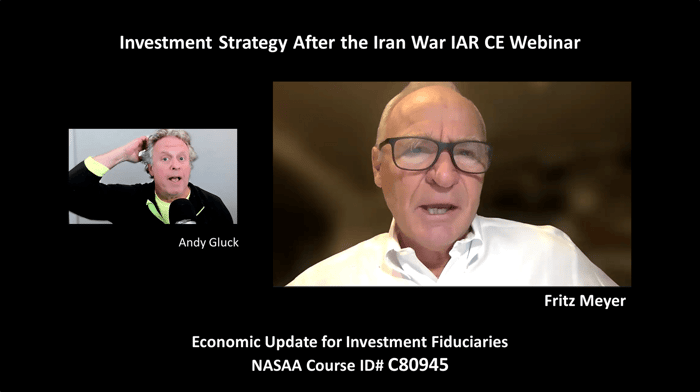
- Investment Strategy After The Iran War IAR CE
- FAQs
What is the Investment Strategy After Iran War IAR CE Webinar?
Investment Strategy After Iran War IAR CE Webinar is a class for investment fiduciaries about how to interpret markets following geopolitical conflict. Methods to evaluate oil prices, inflation expectations, Federal Reserve policy, and corporate earnings are shown to determine whether volatility is temporary. 
Historical performance timeline shows all economic shocks in modern U.S. history, focusing attention on the next three years, not the next three months.
A way of navigating recent geopolitical shocks is offered in the "Investment Strategy After Iran War IAR CE Webinar." The Iran War has disrupted global energy supply, raised questions about inflation, and forced investors to reassess economic expectations. Advisors must now help clients interpret markets during uncertainty while maintaining disciplined portfolio strategies. Investment Strategy After Iran War IAR CE Webinar examines the economic and market implications of the conflict and how financial professionals can respond. The course connects current geopolitical developments to key economic indicators, market behavior, and historical patterns that influence long-term investment outcomes.
Understanding these dynamics helps advisors explain volatility to clients and evaluate whether markets are reacting rationally or emotionally.
Investment Strategy After Iran War IAR CE Webinar gives fiduciaries a way to: |
Interpret PMI signals for economic expansion. Advisors evaluate manufacturing and services PMIs to judge economic momentum and portfolio risk. Assess labor market data shaping economic outlooks. Advisors interpret payroll trends, unemployment rates, and participation data affecting growth. Analyze household net worth and the wealth effect. Advisors explain how rising asset values influence consumer spending and economic resilience. Evaluate demographic drivers of consumer spending. Advisors assess how aging populations affect economic growth and investment demand. Interpret Federal Reserve monetary policy signals. Advisors analyze money supply trends, yield curves, and Fed forecasts affecting markets. Evaluate inflation measures and market expectations. Advisors interpret CPI, PCE, and TIPS spreads to anticipate policy changes. Analyze corporate earnings trends in equity markets. Advisors evaluate forward earnings estimates shaping long-term stock returns. Assess equity valuation using forward P/E ratios. Advisors compare valuations with historical norms when setting allocation strategies. Explain the equity risk premium and volatility. Advisors demonstrate why long-term returns require tolerating short-term market volatility. Apply long-term market arithmetic to portfolio strategy. Advisors interpret earnings growth and dividends driving equity returns. |
Oil prices and the immediate economic shock
The most immediate financial consequence of the Iran war has been the disruption of global oil markets. The Strait of Hormuz is one of the most important energy corridors in the world, carrying a large share of global crude exports. When tensions escalated, shipping risks increased dramatically, creating an immediate supply shock.
Oil prices surged above $100 per barrel as traders priced the possibility of prolonged disruptions. The conflict has reduced oil flows through the Strait of Hormuz, a route responsible for a significant portion of global energy shipments.
Energy shocks matter because they ripple through the entire economy. Rising fuel prices increase transportation costs, production expenses, and consumer prices. Advisors evaluating investment strategy after the Iran war must determine whether the shock is temporary or likely to create longer-term inflation pressures. Investment Strategy After Iran War IAR CE Webinar considers the likely answer to the obvious question your clients are asking: What's next?
Why markets often look beyond geopolitical crises
One of the most counterintuitive lessons for investors is that markets frequently recover from geopolitical shocks faster than expected. War introduces uncertainty, and uncertainty causes volatility. However, once investors understand the economic consequences of a conflict, markets often stabilize quickly.
Historical research shows that markets tend to absorb geopolitical shocks rapidly and return to focusing on economic fundamentals. Investors typically shift attention back to earnings, economic growth, and interest rates once the initial uncertainty fades.
This pattern helps explain why markets sometimes appear resilient even during dramatic world events. Investment Strategy After Iran War IAR CE Webinar explores how markets price geopolitical risk and why investors often begin evaluating future conditions rather than current headlines.
Inflation risks from energy disruption
Energy shocks influence inflation almost immediately. Oil prices affect transportation, manufacturing, and consumer goods costs across the global economy. When supply disruptions push prices higher, inflation expectations can rise quickly.
The Iran war has already driven global oil prices sharply higher as supply disruptions spread across the Middle East energy market. This creates concerns that inflation could remain elevated longer than expected.
Inflation expectations matter because they influence central bank policy. If energy prices remain elevated, central banks may delay interest rate cuts or maintain restrictive monetary policy. In Investment Strategy After Iran War IAR CE Webinar, advisors learn a way to track inflation expectations closely in designing portfolio strategy after the Iran War.
Federal Reserve policy and interest rate expectations
Central banks play a critical role in determining how markets respond to geopolitical shocks. When inflation risks increase, policymakers must decide whether to tighten or loosen monetary policy.
Higher oil prices can complicate this decision. If energy costs push inflation higher, central banks may delay rate cuts even if economic growth slows. Markets constantly adjust to these policy expectations.
Financial professionals must understand the relationship between geopolitical conflict, inflation expectations, and central bank policy. Advisors who understand this relationship can explain market movements to clients more effectively.
Economic indicators guiding the market outlook
Investors rely on economic indicators to determine whether the broader economy remains resilient during geopolitical crises. Manufacturing activity, employment trends, and consumer spending all provide insight into economic momentum.
Strong economic indicators can offset geopolitical concerns. If employment remains stable and consumer spending continues, investors may conclude that economic growth will remain intact despite global conflict.
Advisors evaluating investment strategy after the Iran war should monitor these indicators closely. Economic data helps determine whether market volatility reflects temporary uncertainty or deeper economic challenges.
Corporate earnings remain the primary driver
While geopolitical conflict dominates headlines, corporate earnings ultimately drive stock market performance. Investors care most about whether companies can continue generating profits and growing revenues.
If the Iran war does not significantly disrupt corporate earnings expectations, markets may recover quickly once the initial shock fades. Conversely, prolonged energy disruptions or economic slowdown could reduce profit forecasts.
Investment Strategy After the Iran War IAR CE explores how earnings expectations influence market behavior and why investors often prioritize economic fundamentals over geopolitical developments.
Communicating volatility to clients
During geopolitical crises, advisors must help clients interpret market volatility. News coverage often emphasizes worst-case scenarios, which can cause investors to assume markets will decline dramatically.
Historical evidence suggests that markets usually recover from geopolitical shocks relatively quickly. Investors who react emotionally to short-term volatility risk damaging long-term portfolio performance.
Advisors play an essential role in providing perspective during turbulent periods. By explaining historical market behavior, advisors can help clients maintain disciplined investment strategies. This is the main point advisors are taught to underscore with clients in the Investment Strategy After Iran War IAR CE Webinar.
Preparing portfolios for what comes next
The most important question for investors today is not simply what has happened but what may happen next. Markets continuously evaluate future expectations about growth, inflation, and corporate profits.
Advisors developing investment strategy after the Iran war must consider multiple scenarios. Oil prices could stabilize if shipping routes reopen and energy supply normalizes. Alternatively, prolonged disruptions could create new economic pressures.
Evaluating these scenarios allows advisors to guide clients through uncertainty while maintaining balanced portfolios.
Lessons from past geopolitical conflicts
Financial history offers valuable perspective on how markets respond to war. Markets often react quickly to uncertainty but recover once the scope of the conflict becomes clearer.
Research shows that geopolitical events generally have limited long-term impact on equity markets. Investors who maintain long-term discipline frequently outperform those who attempt to react to every geopolitical headline.
These historical lessons highlight the importance of maintaining perspective during periods of uncertainty.
Why continuing education matters for advisors
Geopolitical events can rapidly reshape economic expectations. Advisors must interpret complex global developments and translate them into clear investment guidance for clients.
The Investment Strategy After Iran War IAR CE Webinar connects current events to economic indicators, market history, and investment principles. The course helps advisors understand how geopolitical shocks influence markets and how to guide clients through uncertainty.
By placing the Iran conflict within historical market context, advisors gain a clearer understanding of how markets process geopolitical risk.
Investment Strategy After The Iran War IAR CE
The central challenge for investors today is determining how markets will respond after the initial shock fades. Oil prices, inflation expectations, central bank policy, and corporate earnings will all shape the market outlook.
Investment Strategy After the Iran War IAR CE provides financial professionals with a framework for interpreting these signals. By understanding how markets react to geopolitical crises, advisors can help clients maintain disciplined investment strategies.
Periods of geopolitical instability highlight the value of perspective and education. Advisors who understand the economic forces shaping markets can guide clients through uncertainty while keeping long-term investment goals firmly in focus.
FAQs
What is the Investment Strategy After the Iran War IAR CE Webinar about?
The Investment Strategy After the Iran War IAR CE Webinar explains how financial professionals interpret markets following geopolitical shocks. The course examines oil supply disruptions, inflation risks, Federal Reserve policy, and how markets process uncertainty after the Iran conflict.
Who should attend the Investment Strategy After the Iran War IAR CE Webinar?
The Investment Strategy After the Iran War IAR CE Webinar is designed for investment adviser representatives, CFP professionals, CIMAs, CPAs, and other fiduciaries who help clients interpret market events and maintain disciplined investment strategy during geopolitical crises.
Why are advisors studying investment strategy after the Iran war?
Advisors are studying investment strategy after the Iran war because geopolitical shocks affect oil prices, inflation expectations, and central bank policy. These factors influence stock valuations, bond yields, and long-term portfolio decisions.
How do geopolitical conflicts typically affect financial markets?
Geopolitical conflicts often trigger short-term volatility as investors reassess risk and economic expectations. However, markets frequently stabilize as investors shift attention back to earnings, economic growth, and interest rate trends.
Why do oil prices matter for investment strategy after the Iran war?
Oil prices influence inflation, transportation costs, and global economic growth. Energy supply disruptions caused by the Iran conflict can raise inflation expectations and affect central bank decisions that shape market performance.
How does the Federal Reserve influence markets after geopolitical shocks?
The Federal Reserve responds to inflation and economic growth expectations. If oil-driven inflation rises after the Iran war, the Fed may delay interest-rate cuts or maintain tighter monetary policy.
What economic indicators help advisors evaluate markets during the Iran war?
Key indicators include manufacturing and services PMIs, employment trends, inflation data, consumer spending, and corporate earnings forecasts. These signals help investors determine whether economic growth remains resilient.
Why do markets sometimes look past geopolitical crises?
Markets price uncertainty quickly and often focus on future economic conditions rather than current headlines. If corporate earnings and economic growth remain strong, markets may recover faster than investors expect.
How should advisors communicate volatility to clients during geopolitical crises?
Advisors should explain that market volatility is common during geopolitical shocks but often temporary. Providing historical perspective helps clients maintain long-term investment discipline.
How does the Investment Strategy After the Iran War IAR CE Webinar help advisors guide clients?
The Investment Strategy After the Iran War IAR CE Webinar provides a framework for interpreting geopolitical risk, evaluating economic indicators, and helping clients understand how markets respond to global conflict.