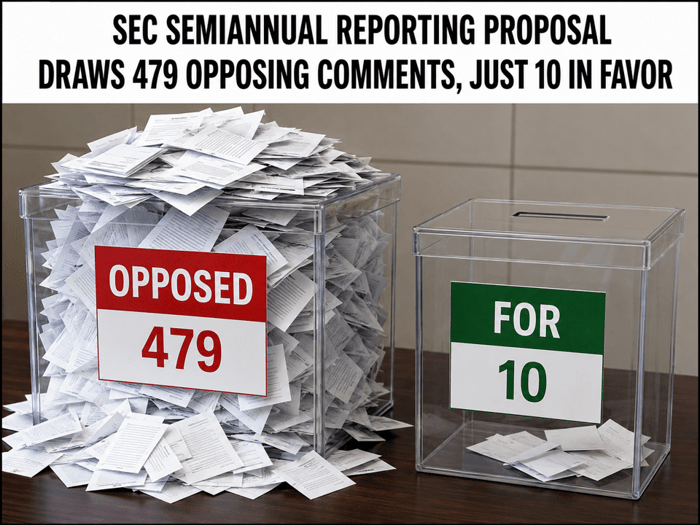

Table of Contents
- SEC Proposal S7-2026-15 ending 10-Q requirements is likely to pass but not untouched
- What adoption of S7-2026-15 would actually change
- Commission-vote math assures adoption
- Why SEC Proposal S7-2026-15 Ending 10-Q Requirements faces a comment-record problem
- Investor protection is the strongest political roadblock
- Market intermediaries are asking for more time
- Prediction markets say timing risk is larger than passage risk
- Why SEC Proposal S7-2026-15 ending 10-Q requirements may be narrowed
- The likely vote is favorable but final product is uncertain
- Why comments on S7-2026-15 ending 10-Q requirements matter
- FAQs
SEC Proposal S7-2026-15 ending 10-Q requirements is likely to pass but not untouched
There is no question whether the Securities & Exchange Commission (SEC) has authority to adopt SEC proposal S7-2026-15 ending 10-Q requirements; it likely does. The better question is whether the proposal to allow semiannual reporting on a new Form 10-S, instead of a quarterly Form 10-Q, survives the comment process in its current form.
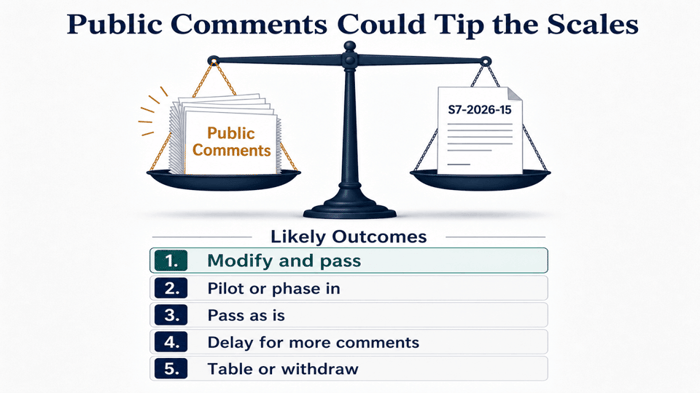
The proposal’s future is uncertain. What is sure is supporters will argue that semiannual reporting will reduce compliance burdens and let companies avoid making decisions based on achieving short-term results. Meanwhile, critics are likely to stress investor protection, transparency, and market confidence. Public comments could therefore have more than the usual influence on whether the SEC adopts the proposed rule as written, narrows it, phases it in, adds conditions, or declines to proceed with it.
Comments are due on or before July 6, 2026. If investor opposition is limited, or if comments strongly emphasize the burdens and short-termism associated with quarterly reporting, the Commission may be more likely to adopt a final rule that more closely resembles the proposal. However, if comments raise substantial investor-protection concerns and are larger in number than expected, the final rule may be narrowed or conditioned.
What adoption of S7-2026-15 would actually change
SEC Proposal S7-2026-15 ending 10-Q requirements would not force companies to stop reporting quarterly. It would give public companies subject to Exchange Act Section 13(a) or 15(d) the option to file one semiannual report on new Form 10-S and one annual report on Form 10-K each fiscal year, instead of three Form 10-Qs and one Form 10-K.
The SEC says the Form 10-S deadline would be 40 or 45 days after the first semiannual period, depending on filer status. In plain English, quarterly reporting would become a choice rather than a mandate for public companies. That distinction matters because many larger companies may keep quarterly earnings releases or calls if investors demand them.
Commission-vote math assures adoption
The SEC has 5 authorized commissioner seats. As of June 18, 2026, only 3 are filled.
SEC Current split: 3 Republicans, 0 Democrats, 2 vacant seats.
| Commissioner | Party |
|---|---|
| Paul S. Atkins, Chair | Republican |
| Hester M. Peirce | Republican |
| Mark T. Uyeda | Republican |
There are 2 open/vacant commissioner slots. So with three Republicans already seated, any additional confirmed commissioners could not also be Republicans unless the current composition changes.
The absence of Democratic commissioners is not because the SEC lacks seats for them; two seats are vacant. The delay lies in the presidential nomination and Senate confirmation process.
Until nominees are confirmed and sworn in, the three Republican commissioners can act without Democratic votes on the Commission.
The strongest clue on the likelihood of adoption of the SEC proposal for semiannual reporting is the composition of the Commission. There are three sitting commissioners are Chair Paul Atkins, Hester Peirce, and Mark Uyeda. Chair Atkins has tied the rule to his “Make IPOs Great Again” agenda. Peirce said she was “pleased to support” the proposal. Uyeda framed the rule around flexibility and the idea that one size does not fit all.
That alignment is why the SEC proposal S7-2026-15 ending 10-Q requirements starts with favorable vote math. Therefore, unless Commission membership changes in ways no one is expecting, the likely final vote is 3-0 if the rule remains recognizably optional semiannual-reporting.
Why SEC Proposal S7-2026-15 Ending 10-Q Requirements faces a comment-record problem
The roadblock is not a lack of Republican votes. It is the administrative record the SEC must defend. The SEC's own Investor Advisory Committee (IAC) has already recommended against eliminating the quarterly reporting mandate, publicly warning that quarterly Form 10-Qs contain financial statements, MD&A, risk, legal-proceeding, and internal-control updates.
The IAC’s critique gives opponents to the proposed rule a ready-made argument: reduced comparability, more information asymmetry, weaker market discipline, and thin evidence that semiannual reporting will improve long-term investment.
For the Commission to ignore the recommendation of its own advisory committee may be unprecedented and raises the stakes for the public's response in the public comments being submitted in the next three weeks. A new self study class provides fiduciaries a detailed guide for promoting public comments. 
To step back from the rule in place since 1970 mandating quarterly financial disclosures would deal a major defeat to investor protection advocates. Supporters of the proposal will be required not merely to repeat the policy slogan that "less frequent reporting reduces burden and promotes free markets," which makes investor protection the strongest political argument against adoption of the semiannual reporting rule as proposed or something similar in effect.
Investor protection is the strongest political roadblock
Investor protection is the strongest objection because it links the process with harm caused to investors. The IAC says the proposal’s benefits are uncertain while the cost to investors is clear. Its recommendation argues that investors use quarterly reports to reallocate capital every three months and that retail investors lack the alternative data, management access, and proprietary tools available to larger institutions. This is coming from the experts named by the SEC Investment Advisory Committee to advise the Commission on such matters. In ignoring IAC, the SEC is discarding advice of the experts it nominated and appointed to the Committee.
This could make SEC Proposal S7-2026-15 ending 10-Q requirements vulnerable to a fairness debate, not just a disclosure-burden argument. Opponents will likely say voluntary earnings releases are not equivalent to reviewed, certified, liability-bearing Form 10-Q disclosure, especially when companies have incentives to disclose good news and delay announcing bad news.
Market intermediaries are asking for more time
The Securities Industry Financial Markets Association (SIFMA) and SIFMA Asset Management Group asked the SEC for a 60-day comment extension, saying the proposal raises “complex and technical issues.” Their concerns are not abstract.
SIFMA pointed to underwriters’ due diligence; SIFMA AMG pointed to the timeliness of investor information and comparability among companies reporting on different cadences.
A later comment submitted by the Mutual Fund Association, Alternative Investment Management Association (AIMA), and SIFMA Asset Management said the proposal would fundamentally restructure a disclosure framework relied on for more than 55 years. It was not a veto. But it is the kind of institutional feedback that can force SEC staff to slow down, strengthen the economic analysis, and consider safeguards before putting to a Commission vote SEC proposal S7-2026-15 ending 10-Q requirements.
Prediction markets say timing risk is larger than passage risk
Prediction markets may offer a useful snapshot of political expectations, but they deserve only modest weight here because they are conditional. SEC rulemaking is a technical process shaped by statutory authority, staff analysis, public comments, investor-protection concerns, and litigation risk. For a specialized proposal like S7-2026-15, market odds may reflect sentiment more than a fully informed assessment of how the Commission will ultimately write a final rule. Still, you may want to give some consideration of what a check of Kalshi and Polymarket revealed.
Kalshi’s market is deadline-specific: it showed an 18% likelihood for final SEC action before Jan. 1, 2027, and 40% before Apr. 1, 2027. These are very specific conditions, which makes it hard to use the data to draw conclusions about the likelhood of adoption of S7-2026-15.
Polymarket’s 2026 market showed about 19% “Yes,” with its rules resolving only if the SEC approves a qualifying rule by Dec. 31, 2026. Those prices do not directly answer whether the SEC proposal S7-2026-15 ending 10-Q requirements will ever be adopted. They mainly price timing, wording, and resolution risk. Again, it's wise to carefully weight the give prediction markets only modest weight. However, they support caution on 2026 adoption and do not override the Commission alignment that supports eventual adoption in some form.
Why SEC Proposal S7-2026-15 ending 10-Q requirements may be narrowed
The proposal itself invites narrowing. The SEC asks whether semiannual reporting should be available only to companies satisfying certain criteria, including emerging growth companies or smaller reporting companies, and whether a pilot program should be considered. That is a major clue of where may be ultimately landing.
If comments from investors, analysts, exchanges, underwriters, and asset managers are sharply negative, the Commission can preserve the policy win while reducing litigation risk.
A narrower final rule could limit eligibility, phase in adoption, require enhanced Form 8-K treatment for voluntary earnings releases, or condition the option on clearer investor notice. That is why odds are higher for some limited option of SEC proposal S7-2026-15 ending 10-Q requirements as written.
The likely vote is favorable but final product is uncertain
No final vote is scheduled yet. The SEC rule page lists comments due July 6, 2026, and the current meetings page lists closed meetings, not an open meeting for this rule. The Commission also can act without convening an open meeting. If the current three-member Commission votes on a final optional semiannual rule, expect adoption. The political uncertainty is not the roll call; it is whether staff can write an adopting release that deals credibly with cost-benefit objections, investor-protection concerns, and market-structure comments. The SEC proposal S7-2026-15 ending 10-Q requirements will be tested less by ideology than by the public record of comments and opposition from the IAC.
Why comments on S7-2026-15 ending 10-Q requirements matter
Comments matter here because this rule sits at the intersection of capital formation and fiduciary risk. Advisers, analysts, and investors are not just debating paperwork; they are debating the cadence of standardized information in public markets. If the SEC proposal S7-2026-15 ending 10-Q requirements is adopted with a broad scope, investors may have to compare quarterly filers against semiannual filers, adjust monitoring practices, and reassess how stale financial statements affect capital-raising decisions. If the rule is narrowed, comments will likely explain why. The comment file is the battlefield, a legal record, and a moment for fiduciaries. Silence leaves the comments to others.
FAQs
What is SEC Proposal S7-2026-15?
SEC Proposal S7-2026-15 is a proposed rule that would allow certain public companies to shift from mandatory quarterly Form 10-Q reporting to a semiannual reporting model using a new Form 10-S.
Would SEC Proposal S7-2026-15 eliminate Form 10-Q filings?
Not necessarily. The proposal would not force companies to stop filing quarterly reports. Instead, it would make quarterly reporting optional for eligible public companies that choose to use semiannual reporting.
What would replace quarterly Form 10-Q reports?
Under the proposal, companies could file one semiannual report on new Form 10-S and one annual report on Form 10-K each fiscal year, instead of three Form 10-Qs and one Form 10-K.
Why is the SEC considering ending mandatory 10-Q requirements?
Supporters argue that semiannual reporting could reduce compliance burdens, lower costs, and help companies focus less on short-term quarterly performance.
Why do critics oppose SEC Proposal S7-2026-15?
Critics argue that ending mandatory quarterly reporting could reduce transparency, weaken investor protection, increase information asymmetry, and make it harder for investors to compare companies.
Is SEC Proposal S7-2026-15 likely to pass?
The proposal appears likely to receive support from the current Commission, but it may not pass in its original form. Public comments, investor-protection concerns, and market-structure objections could lead the SEC to modify, narrow, phase in, or delay the rule.
What are the most likely outcomes for SEC Proposal S7-2026-15?
The most likely outcome may be a modified final rule. Other possibilities include adoption as proposed, narrowed eligibility, a pilot or phased-in approach, delay for additional comments, or tabling the proposal.
Why do public comments matter for S7-2026-15?
Public comments matter because they become part of the administrative record the SEC must consider and defend. Strong investor-protection objections could make the final rule narrower or more conditional.
When are comments due on SEC Proposal S7-2026-15?
According to the post, comments are due on or before July 6, 2026.
How could SEC Proposal S7-2026-15 affect investors?
If adopted broadly, investors may have less frequent standardized financial information from some companies. That could affect capital allocation, due diligence, comparability, and monitoring of public companies.
Would companies still hold quarterly earnings calls?
Many companies may continue quarterly earnings releases or calls if investors demand them, even if quarterly Form 10-Q filing becomes optional.
What is the strongest argument against ending mandatory 10-Q reporting?
The strongest argument is investor protection. Opponents argue that voluntary earnings releases are not equivalent to reviewed, certified, liability-bearing Form 10-Q disclosures.
Could the SEC narrow the final rule?
Yes. The SEC could limit semiannual reporting to certain companies, such as smaller reporting companies or emerging growth companies, require additional disclosures, create a pilot program, or phase in the rule over time.